
Advertising Disclosure: This site may receive compensation for service connections made through this page. Content is editorially independent.
HVAC maintenance recommendations fall into three honest categories. Necessary (the four items that actually prevent expensive failures): filter checks on the schedule ENERGY STAR recommends, a white-vinegar flush of the condensate drain line, outdoor unit clearance, and (for warranty-protected equipment) the annual professional tune-up. Overkill (the items pushed by contractor marketing that you can usually skip): annual refrigerant top-off without a documented leak, premium chemical coil cleaning on an unfouled coil, and "anti-microbial" duct treatments. Optional (the items whose value depends on your specific equipment age, climate, and warranty): duct sealing, UV lamp installation, premium tune-up upgrades beyond the standard package. A seasonal tune-up runs $80 to $200 per visit on our cost guide; premium add-ons stacked on top of it are where you should ask what you are actually buying. This article is the framework for telling them apart -- written by a referral service that does not perform HVAC work itself.
You scheduled an HVAC tune-up because the website said it was important, or the manufacturer warranty mentioned annual maintenance, or you remembered to. The technician arrives, does some unspecified work, and presents an invoice. Sometimes the invoice has measurable numbers (refrigerant pressures, capacitor microfarads, blower amperage). Sometimes it just says "tune-up complete" and lists the tune-up charge plus a "premium service upgrade" that you don't remember authorizing. You pay, you make a mental note that HVAC stuff is expensive, and the cycle repeats next spring.
There is a better framework than "everything they recommend is necessary" or "all HVAC maintenance is a scam" -- both extremes are wrong. This article is an item-by-item editorial position on which industry-recommended maintenance tasks genuinely earn their cost, which ones are upsell padding that homeowners can safely skip, and how to tell which manufacturer-warranty clauses are actually enforceable. The C6 pillar (our year-round HVAC maintenance playbook) describes what a real tune-up looks like in measurable steps. This article is the upstream question: of the items typically recommended, which ones should you actually pay for?
The Four Maintenance Tasks That Actually Prevent Failures
Four maintenance activities earn their cost on almost any system. Each one has published guidance behind it from ENERGY STAR or the equipment makers. Do these.
1. Air filter replacement (DIY, on the ENERGY STAR schedule)
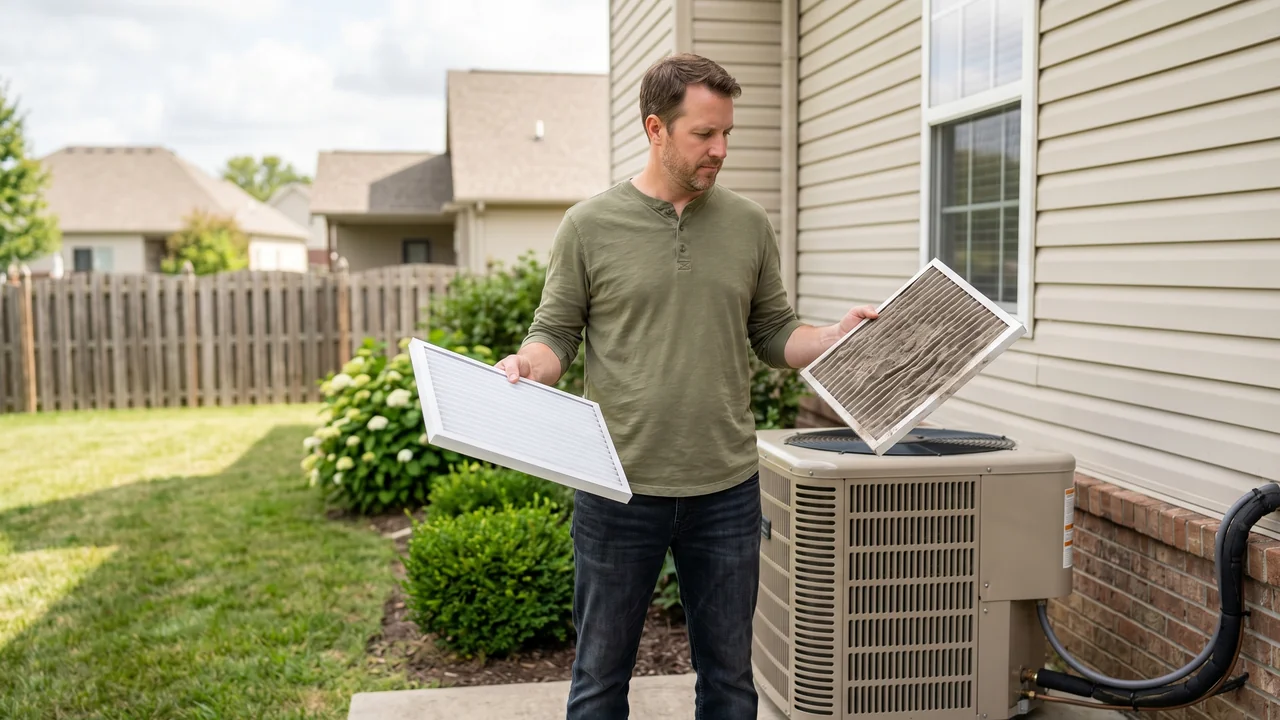
ENERGY STAR recommends checking your filter every month, especially during heavy-use months in winter and summer; if it looks dirty after a month, change it, and change it at least every 3 months. The visual check is the right rule -- hold the filter up to light, and if you cannot see light through it, replace it regardless of how recently it was installed.
Why this is non-negotiable: ENERGY STAR says a dirty filter slows air flow and makes the system work harder, and its maintenance checklist warns that a dirty filter “can increase energy costs and damage your equipment, leading to early failure.” A replacement filter costs far less than any repair on our cost guide, which makes the monthly filter check the cheapest maintenance habit you have.
2. Condensate drain line flush (DIY, white vinegar)
In cooling mode the evaporator coil pulls moisture out of the air, and the drain line carries that water out of the air handler to a floor drain, an exterior discharge, or a condensate pump. ENERGY STAR’s maintenance checklist warns that “a plugged drain can cause water damage in the house and affect indoor humidity levels.” Trane and Carrier both suggest asking your technician to show you how to pour a cup of distilled vinegar down the drain line to help prevent clogs. Have the technician point out your line’s access point during a tune-up and ask how often your system needs the flush. If the drain is already clogged or water is overflowing, turn the thermostat off and call a technician. The HVAC water-leak diagnostic article covers the failure mode in detail.
3. Outdoor unit clearance (DIY, seasonal)
Clear vegetation, fallen leaves, and accumulated debris from around the outdoor condenser unit without touching the unit itself. Anything crowding the unit restricts the airflow its coil needs to shed heat. This is a quick visual check during spring startup and fall shutdown plus an after-storm sweep when debris has accumulated. Do not spray, hose, or otherwise clean the unit yourself -- coil cleaning is on the contractor side of ENERGY STAR’s maintenance checklist. The clearance check just means moving things AWAY from the unit, not touching it.
4. Annual professional tune-up (for warranty-protected equipment)
For HVAC equipment with an active manufacturer parts warranty, the annual professional tune-up is the documented service event that keeps the warranty valid. The specific warranty consequence varies by manufacturer -- some void coverage entirely if maintenance is skipped; some only void specific components attributable to lack of maintenance. A seasonal tune-up runs $80 to $200 per visit on our cost guide, and ENERGY STAR’s maintenance checklist recommends annual pre-season check-ups by a contractor: the cooling system in the spring and the heating system in the fall. For an aging system near the end of its warranty term, the math is lopsided: a tune-up visit costs a fraction of an out-of-warranty compressor replacement ($1,200 to $3,500 on the same cost guide).
For newer equipment with no warranty maintenance requirement, the case for the annual visit is weaker, and skipping a year is a judgment call rather than an obvious mistake. As equipment ages, the wear items a tune-up measures — capacitors, contactors, refrigerant charge, the condensate drain — become the main reason to keep the visit on the calendar.
A technician can run an honest tune-up and show you the measured numbers on the invoice -- no premium upsell required.
Call Now — (844) 582-1795Disclosure: We are a referral service and may receive compensation for qualified calls. Calls may be routed to an independent provider network and may be recorded. Pricing and availability vary by provider and location.
The Three Items That Look Like Maintenance but Are Mostly Upsell
These three line items show up frequently on contractor websites and "premium tune-up" invoices. Our editorial position is that each one, on a system that does not have the specific problem it claims to address, is money spent without proportional risk reduction. Skip them unless one of the specific exceptions below applies.
1. Annual refrigerant top-off without a documented leak
Refrigerant circulates inside the system: Trane describes it moving through the system during the refrigeration cycle, changing from liquid to gas as it transfers heat, and says the best way to confirm a leak is a technician with leak-detection equipment. If a system needs refrigerant added year after year, it is losing refrigerant somewhere, and that leak should be found and repaired, not topped off. Under EPA Section 608, technicians who service equipment that could release refrigerant must be EPA-certified, and intentionally venting refrigerant is prohibited. EPA’s leak-repair requirements apply only to appliances holding 50 or more pounds of refrigerant, which leaves out typical home systems — so no federal rule forces a leak search on your system; you have to ask for one. "Topping off" as routine annual maintenance covers up the leak rather than fixing it, and ENERGY STAR notes that too little refrigerant makes a system less efficient and reduces the life of the equipment.
The contractor framing that makes this an upsell: "we noticed the refrigerant was a bit low so we added some." If the technician proposes a top-off without showing you the leak-source diagnosis on the invoice, ask for the leak report before authorizing the charge. A legitimate refrigerant addition should be preceded by a leak search (for example, with an electronic leak detector) of the joints, valves, and coil; the leak source is documented; the leak is either repaired (for system-side leaks) or the equipment is replaced (for coil-side leaks that exceed repair cost). The C1 cluster's refrigerant leak article covers the diagnostic in detail.
2. Premium chemical coil cleaning on an unfouled coil
ENERGY STAR’s maintenance checklist puts cleaning the evaporator and condenser coils on the contractor’s check-up list, and our year-round HVAC maintenance playbook expects the technician to include a condenser coil rinse in a standard spring tune-up. For a unit with coil fouling that a plain rinse cannot remove — for example in coastal salt air, near agricultural fields, or on a coil that has gone years without cleaning — the technician’s chemical coil cleaner is legitimate: it is applied, left to work, rinsed off, and the coil is inspected.
For a unit with a clean-looking coil on a young system in a typical suburban setting, a separate "premium coil cleaning" upcharge is hard to justify: a chemical cleaner has little to remove from a coil that wasn't fouled to begin with. The exception worth noting: if your manufacturer warranty specifies documented coil cleaning, follow the warranty. Read the warranty document for your specific equipment before deciding.
3. "Anti-microbial" or "anti-bacterial" duct treatments
Sold as a premium add-on, anti-microbial duct treatments are chemical biocides applied to the interior duct surfaces, intended to suppress mold and bacterial growth. The evidence base is weak. EPA’s consumer guidance on duct cleaning says “EPA does not recommend that the air ducts be cleaned routinely, but only as needed,” and that “duct cleaning has never been shown to actually prevent health problems.” On biocides and sealants specifically, EPA says research “has not demonstrated their effectiveness in duct cleaning or their potential adverse health effects,” and that they should be applied, if at all, only after the system has been properly cleaned.
The scenarios where EPA says duct cleaning is worth considering: substantial visible mold growth inside hard-surface ducts or on other system components, ducts infested with rodents or insects, or ducts clogged with excessive dust and debris. In any of those cases, the right intervention is a professional duct cleaning scoped to that problem, not a maintenance-cycle anti-microbial spray — and EPA’s advice is blunt: “Do not hire duct cleaners who recommend duct cleaning as a routine part of your heating and cooling system maintenance.” For a typical home with clean ducts and no visible issues, this line item is the clearest "skip" on a tune-up invoice.
Manufacturer Warranty Reality: What's Actually Required, What's Recommended
Many residential HVAC manufacturer warranties include a clause referencing annual professional maintenance, but the specific requirement, the documentation needed, and the consequence for skipping vary substantially. There is no universal rule. The right move is to find the original manufacturer warranty document for your specific equipment and read the maintenance clause directly.
The installer should have provided the warranty registration documentation at install. If not, the manufacturer's website may have a warranty PDF searchable by model number. Look for three specific things:
- Is annual maintenance required or recommended? Some warranties use binding language ("must be serviced annually by a qualified HVAC contractor"); others use non-binding language ("we recommend annual maintenance"). The first is a condition of coverage; the second is advice.
- What documentation is required? Some warranties accept any HVAC contractor invoice; some require manufacturer-trained technicians; some require specific service codes on the invoice. Without the right documentation, the maintenance still happened but the warranty coverage may not.
- What is the consequence of missing a year? Some warranties void coverage entirely; some only void coverage for failures attributable to lack of maintenance (compressor seizure from low refrigerant charge, for example).
If the warranty requires annual service with documentation, the tune-up fee ($80 to $200 per visit) is essentially the cost of keeping coverage active -- far less than an out-of-warranty compressor replacement at $1,200 to $3,500, both per our HVAC cost guide. If the warranty only "recommends" maintenance, the math is closer to optional.
How Climate Changes the Math
The right maintenance cadence and the right item priorities shift with climate. Four concrete markets to illustrate:
Tucson, Arizona (hot-dry): The condensate drain is less critical (low humidity means less condensate), but outdoor unit clearance and filter changes are essential. ENERGY STAR’s advice to check the filter monthly matters most in heavy-use summer months, and in a dusty climate that monthly check is how you catch a filter loading up early. Where cooling dominates the year, the spring tune-up’s capacitor test and refrigerant pressure check are the high-value visit.
Newark, New Jersey and Columbus, Ohio (cold winters): The fall furnace tune-up is the high-value visit -- gas pressure, heat exchanger inspection, and combustion CO measurement catch the failure modes specific to gas-furnace winter operation. EPA recommends that a fuel-burning furnace be “inspected for proper functioning and serviced before each heating season to protect against carbon monoxide poisoning” (EPA). The spring AC tune-up is lower-stakes in markets where AC runs only a few months a year. The CDC advises checking CO detector batteries “when you change the time on your clocks each spring and fall,” so pair the fall check with the furnace visit.
Dallas, Texas (mixed-humid, both AC and furnace get heavy use): Both spring AC and fall furnace tune-ups are high-value -- AC for the hot-humid summer load on the compressor, furnace for cold-snap reliability. The condensate drain matters more here because humid air means more condensate across a long cooling season; ask your technician how often your line needs the vinegar flush.
⚠️ Warranty caveat: The manufacturer-warranty information here is general guidance. Warranty terms, registration requirements, and maintenance clauses vary by manufacturer and equipment generation -- confirm your specific equipment's warranty by reading the manufacturer-provided document or checking the manufacturer's website by model number before relying on any specific position taken in this article.
The DIY Boundary: What Homeowners Do, What Technicians Do
Our editorial safety policy draws the line tightly. Homeowners handle five things: replacing the air filter, operating the thermostat (including turning it off), moving leaves and debris away from the outdoor unit without touching it, flushing the condensate drain line with white vinegar, and calling a technician. Everything else is technician work. ENERGY STAR’s maintenance checklist points the same way: the air filter is the item it lists under “Actions To Do Yourself,” and it assigns the rest of the check-up to a contractor.
That contractor task list is explicit: checking the refrigerant level, cleaning evaporator and condenser coils, tightening electrical connections and running electrical tests on motors, and checking that the system starts, runs, and shuts off properly. The full list of measurable diagnostics performed on a real tune-up (capacitor capacitance test, refrigerant pressure measurement, blower amperage, electrical connection torque, temperature differential, gas pressure, heat exchanger inspection, combustion CO measurement) is documented in the C6 pillar's real-tune-up section.
Three categories are firmly off-limits to homeowners regardless of perceived simplicity. Refrigerant handling is federally regulated under EPA Section 608, which requires technicians who service refrigerant-containing equipment to be certified. Capacitor work -- capacitors can hold a dangerous charge even after power is cut; discharging them requires technician training. Gas connections -- gas leaks are 911-tier emergencies, and gas-line work requires the right tools and training to verify zero leakage post-service. Even simple-seeming tasks like tightening an electrical terminal at the disconnect or cleaning the outdoor coil with a chemical cleaner cross the boundary because they involve voltage that can kill or refrigerant systems regulated under federal law. The C6 article on what a technician actually does covers the full task list and why each one stays in the technician's scope.
Trusted Industry Sources
The maintenance recommendations, federal-source citations, and warranty positions in this article are consistent with published guidance from:
- EPA — Section 608 Technician Certification
- ACCA — Technical Manuals (Manual J, D, S)
- CDC — Carbon Monoxide Poisoning
- ENERGY STAR — HVAC Maintenance Checklist
- EPA — Should You Have the Air Ducts in Your Home Cleaned?
- AHRI — Residential Equipment Certification
- U.S. Department of Energy — Purchasing Energy-Efficient Central Air Conditioners
A technician can show you the measured numbers (capacitor microfarads, refrigerant pressure, blower amperage) -- no premium upgrades required.
Call Now — (844) 582-1795Disclosure: We are a referral service and may receive compensation for qualified calls. Calls may be routed to an independent provider network and may be recorded. Pricing and availability vary by provider and location.
Frequently Asked Questions
For aging equipment, and for any system whose manufacturer warranty requires annual service, yes. ENERGY STAR recommends annual pre-season check-ups by a contractor (the cooling system in the spring, the heating system in the fall), and a seasonal tune-up runs $80 to $200 per visit on our cost guide. The visit measures the wear items that tend to fail without much warning: capacitors, contactors, refrigerant charge, and the condensate drain. Two qualifiers matter: the tune-up must be a real tune-up, with measured numbers shown on the invoice, not a quick drive-by; and the homeowner still handles the basics (checking the filter monthly, the white-vinegar flush of the drain line, and keeping debris away from the outdoor unit) whether or not annual service is scheduled. For newer equipment with no warranty maintenance requirement, the case is closer to break-even, and skipping a year is a judgment call.
Per ENERGY STAR guidance, check the filter every month, change it if it looks dirty after a month, and change it at least every 3 months. The visual check is the right rule: hold the filter up to light; if you cannot see light through it, replace it regardless of how recently it was installed. Filters are the cheapest preventive maintenance on the system — ENERGY STAR notes that a dirty filter slows air flow and makes the system work harder, and that it can increase energy costs and damage your equipment, leading to early failure.
No. Refrigerant circulates inside the system: Trane describes it moving through the system during the refrigeration cycle, changing from liquid to gas as it transfers heat. If a system needs refrigerant added year after year, it is losing refrigerant somewhere, and that leak should be found and repaired, not topped off. Under EPA Section 608, technicians who service equipment that could release refrigerant must be EPA-certified, and intentionally venting refrigerant is prohibited. EPA’s leak-repair requirements apply only to appliances holding 50 or more pounds of refrigerant, which leaves out typical home systems, so no federal rule forces a leak search on your system — you have to ask for one. A contractor that quotes "annual refrigerant top-off" as routine maintenance is covering up a leak rather than fixing it, and ENERGY STAR notes that too little refrigerant makes a system less efficient and reduces the life of the equipment. If a technician proposes a top-off without documenting a leak diagnosis, ask for the leak-source report before authorizing the charge.
Usually not. A standard spring AC tune-up ($80 to $200 per visit on our cost guide) should include measurable checks — capacitor capacitance, refrigerant pressure, blower amperage, electrical connections, temperature differential. Premium add-ons (chemical coil cleanings, "anti-microbial" duct treatments, expanded electrical-test packages) cost extra without a measurable change in reliability for a system that does not have the problem they target. Two exceptions justify the premium tier: coil fouling that a standard rinse cannot remove (the chemical cleaner becomes legitimate), and a manufacturer-warranty clause that requires documented coil cleaning. For an unfouled coil on a young system, the standard tune-up does the job.
Many residential HVAC manufacturer warranties include a clause referencing annual professional maintenance, but the requirement, the documentation specifics, and the warranty consequence for skipping vary substantially by manufacturer — there is no universal rule. The right move is to find the original manufacturer warranty document for your specific equipment (the installer should have provided it; if not, the manufacturer's website may have a warranty PDF by model number) and read the maintenance clause. Look for three things: whether annual maintenance is required (some warranties say "recommended" which is non-binding), what documentation is required (some accept any HVAC contractor invoice; some require manufacturer-trained technicians or specific service codes on the invoice), and what the consequence is for missing a year (some void the warranty entirely; some only void the parts coverage for failures attributable to lack of maintenance). If the warranty requires annual service, the tune-up fee ($80 to $200 per visit on our cost guide) is essentially the cost of keeping the warranty valid — far less than an out-of-warranty compressor replacement at $1,200 to $3,500.
ENERGY STAR’s maintenance checklist lists the air filter under "Actions To Do Yourself" and leaves the rest of the check-up to a contractor. Our own safety policy limits homeowners to five things: replacing the air filter, operating the thermostat (including turning it off), moving leaves and debris away from the outdoor unit without touching it, flushing the condensate drain line with white vinegar, and calling a technician. Everything else is technician work — refrigerant charge check, leak testing, coil cleaning, fin straightening, electric control sequence verification, gas pressure measurement, heat exchanger inspection, combustion CO measurement, and any cabinet panel removal. Refrigerant handling is federally regulated under EPA Section 608, which requires technicians who service refrigerant-containing equipment to be certified. Never attempt to test capacitors, work on electrical connections, or open cabinet panels regardless of the perceived simplicity — capacitors can hold a dangerous charge even after power is disconnected.
Local HVAC Service Areas
Cool Call Pro connects homeowners with independent HVAC technicians nationwide. Find a pro in Newark (NJ), Columbus (OH), Dallas (TX), or Tucson (AZ), or browse by state: New Jersey, Ohio, or all locations.