
Advertising Disclosure: This site may receive compensation for service connections made through this page. Content is editorially independent.
If your HVAC is leaking water indoors, a clogged condensate drain line is one of the typical causes (drain pan and condensate line repairs run $75–$250 per our cost guide). Turn the system off at the thermostat and mop up standing water — EPA advises drying water-damaged areas within 24–48 hours to prevent mold growth. Other causes include a cracked drain pan, a frozen evaporator coil, or a dislodged drain line. Ask your technician about adding a safety float switch to prevent future overflow.
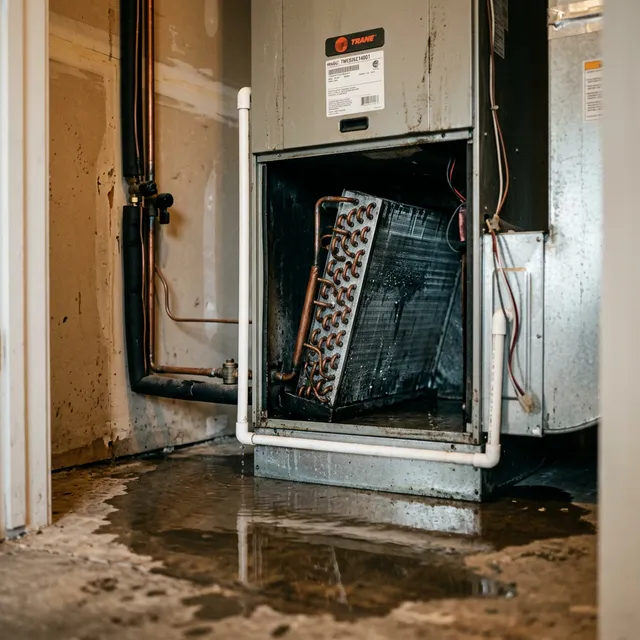
You walk into the room and there is a puddle of water near your indoor HVAC unit — or worse, water dripping from a ceiling vent. A clogged condensate drain line is one of the typical causes listed in ACCA's guide to HVAC condensate — the drain line is a PVC pipe that carries moisture removed from your indoor air to the outside. When it clogs, water backs up and overflows onto your floor, into walls, or through the ceiling.
Water damage is time-sensitive. EPA advises drying water-damaged areas and items within 24 to 48 hours to prevent mold growth. The steps below will help you limit the damage and tell a technician what they need to know. If your AC has other symptoms too, start with our complete AC troubleshooting guide.
First: Stop the Damage Right Now
Before diagnosing anything, limit the water damage:
- Turn off your AC at the thermostat. This stops the system from producing more condensation. Switch it to OFF — not FAN ONLY.
- Mop up standing water immediately. Use towels, a mop, or a wet/dry vacuum. Pay extra attention to water near electrical outlets, the furnace, or the air handler.
- Move furniture and electronics away from the wet area to prevent further damage.
- Place towels or a shallow pan under the drip point to catch any remaining water.
Do not step in standing water near your HVAC system. Indoor air handlers and furnaces run on household line voltage. If water has reached the electrical panel, the air handler, or any exposed wiring, do not touch anything, and do not try to kill the power at the electrical panel yourself: set the thermostat to OFF only if you can reach it without standing in water, stay away from the water and the equipment, and call a technician immediately.
Get connected with a technician in your ZIP code.
Call Now — (844) 582-1795Disclosure: We are a referral service and may receive compensation for qualified calls. Calls may be routed to an independent provider network and may be recorded. Pricing and availability vary by provider and location.
Cause #1: Clogged Condensate Drain Line
Your AC does not just cool the air — it removes humidity. The evaporator coil inside the air handler gets cold, and warm humid air passing over it causes water to condense on the coil, just like water forming on a cold glass on a summer day. That condensation drips into a drain pan and flows out through a PVC condensate drain line to the outside of the house or into a floor drain.
What clogs the line:
- Algae and mold growth — the dark, wet environment inside the drain line is a breeding ground; ACCA notes that bacteria and fungus building up in the drain line can clog it.
- Dust and debris — particles from indoor air get pulled through the system and settle in the drain pan, eventually washing into the line.
- Insect nests — the outdoor end of the drain line is an open pipe, and insects sometimes build nests inside it.
In humid climates like Atlanta and New Orleans, long, humid cooling seasons mean the drain line carries water for much of the year, which gives algae and debris more time to build up.
How a technician fixes it: They use a wet/dry vacuum on the outdoor end or a specialized CO2 clearing tool to blow the clog out. They then flush the line with a cleaning solution and may install a safety float switch — a device that automatically shuts off the AC if the drain pan fills up, preventing future overflow and water damage.
Cause #2: Cracked or Rusted Drain Pan
The drain pan sits directly beneath the evaporator coil and catches all the condensation. Many systems have two pans:
- Primary pan — a built-in metal pan welded into the air handler. ACCA notes that after years of use, drain pans can corrode or crack.
- Secondary (overflow) pan — a removable plastic or metal pan that sits underneath the entire air handler as a backup. If the primary pan or drain line fails, this pan catches the overflow.
If the primary pan is cracked, water drips right through it and bypasses the drain line entirely. If the secondary pan is damaged or missing, there is no backup to catch the overflow.
A technician can patch small cracks with epoxy as a temporary fix, but a cracked primary pan can mean the pan or the entire air handler coil assembly needs replacement. Ask the technician whether your system has a secondary pan and whether one should be added.
Cause #3: Frozen Evaporator Coil
If the evaporator coil freezes — you may see ice on the copper lines or frost visible through the air handler access panel — the ice eventually melts and produces far more water than the drain pan can handle.
A frozen coil is not a standalone problem — it is a symptom of something else:
- Low refrigerant — a leak in the refrigerant lines drops the coil temperature below freezing. Refrigerant work is federally regulated: EPA's Section 608 rules require technicians who service equipment that could release ozone-depleting refrigerants to be certified. Refrigerant is never a homeowner task; ask the technician on the call to confirm they hold a Section 608 certification before they arrive.
- Restricted airflow — a clogged air filter, closed supply vents, or a failing blower motor reduces the warm air flowing over the coil, causing it to freeze. This is the same mechanism described in our guide on AC blowing warm air.
- Failing blower motor — if the blower is running at reduced speed, there is not enough airflow to keep the coil above freezing.
What to do: Turn the AC off and set the fan to ON to circulate warm air over the coil. Let it defrost completely; this can take hours. Place towels around the air handler to catch the melt water. Do not turn the AC back on until a technician identifies and fixes the root cause.
Cause #4: Disconnected or Loose Drain Line
The PVC condensate drain line connects to the drain pan with a fitting. Over time, vibration from the air handler can loosen this connection, or a previous repair may not have resealed it properly. When this happens, water drips from the connection point instead of flowing through the pipe.
Attic-mounted air handlers deserve extra attention, because a leak there shows up on the ceiling below. If your HVAC system is in the attic and you see water stains on the ceiling below it, a disconnected drain line is a strong possibility.
A technician can reseat and seal the connection. Ask for the price before work starts; the diagnostic fee alone is $65–$150 per our cost guide.
Cause #5: Dirty Air Filter Causing a Freeze-Thaw Cycle
A severely clogged air filter restricts airflow over the evaporator coil. Without enough warm air flowing across it, the coil temperature drops below 32°F and ice forms on the coil surface. The system may cycle off (from a safety switch or the thermostat reaching set temperature), the ice melts, and the drain pan overflows because the sudden rush of melt water is too much for a partially clogged drain to handle.
This creates a frustrating cycle: the AC runs, the coil freezes, the system shuts off, ice melts and leaks water, the AC restarts, and it happens again. In Charlotte and other Southeast cities with long cooling seasons, the system runs for many hours, so a neglected filter has more opportunity to start this cycle.
The fix is simple: Replace the air filter. But if the drain line is also partially clogged (which is likely if the filter was neglected), you need a technician to clear the drain as well.
When to Call a Technician
Call an HVAC technician if:
- Water is actively dripping from a ceiling vent or the air handler — this means the drain pan is overflowing
- You see ice or frost on the refrigerant lines or evaporator coil — this indicates low refrigerant or a blower problem
- The water leak returns after you turned the AC back on — the drain line is still clogged or the pan is cracked
- There is a musty or moldy smell coming from the vents — this suggests mold growth in the drain pan or ductwork
- Your system does not have a safety float switch — a technician can install one to prevent future overflow
- You see water damage on walls, ceiling, or flooring — the technician can assess the source, and you may need to file a homeowner's insurance claim for the water damage
Tell the technician: "My AC is leaking water inside the house. The water is coming from [the air handler / the ceiling vent / the furnace area]. I turned the AC off [X] hours ago." This helps them bring the right equipment on the first visit.
What the Repair Will Cost
These ranges come from our cost guide. Your actual cost will vary based on your region, the provider, and system specifics.
| Repair | Estimated Cost | DIY? |
|---|---|---|
| Drain pan / condensate line repair | $75–$250 | No |
| Refrigerant recharge, R-410A (if coil froze from a leak) | $150–$600 | No |
| Evaporator coil replacement | $600–$2,000 | No |
| Diagnostic service call | $65–$150 | — |
Ranges from our HVAC cost guide. Actual costs vary by region, provider, and system.
EPA advises drying water-damaged areas and items within 24 to 48 hours to prevent mold growth. If water has soaked into walls or ceiling material, use fans and a dehumidifier to dry the area as quickly as possible. If there has been a lot of water damage or mold covers more than about 10 square feet, EPA's guide refers you to its more detailed remediation guidance; consider calling a water damage restoration company in addition to your HVAC technician.
How to Prevent HVAC Water Leaks
- Check the air filter monthly. ENERGY STAR advises checking it every month, especially in summer and winter, changing it if it looks dirty, and changing it at least every 3 months. A clean filter helps prevent the freeze-thaw cycle that overwhelms the drain system.
- Schedule annual maintenance. ENERGY STAR's maintenance checklist recommends a pre-season contractor check-up and includes inspecting the condensate drain, noting that a plugged drain can cause water damage. See our maintenance guide, and ask the technician to check the drain pan and float switch too.
- Ask about a safety float switch. If your system does not have one, ask your technician about adding one during the next service visit. It shuts off the AC when the drain pan starts to fill, before it overflows. Get the price before the work starts.
- Flush the drain line with vinegar. Trane and Carrier suggest asking your technician to show you how to pour a cup of distilled vinegar down the condensate drain line to help prevent clogs. If the line is already clogged, turn the thermostat off and call a technician instead.
- Keep the outdoor drain line end clear. Look at the PVC pipe exit outside your house periodically without touching or removing anything. Keep mulch, dirt, and landscaping pulled back from it.
- Ask about the secondary drain pan. If your air handler is in the attic or above a finished ceiling, ask your technician to confirm the secondary (overflow) pan is in place and not cracked. It is the backup before water hits your ceiling.
- Know your system age. Drain pans can corrode or crack after years of use. If your system is older and you are noticing frequent water issues, it may be time to consider replacing the air handler.
Frequently Asked Questions
A clogged condensate drain line is one of the typical causes of condensate overflow listed in ACCA's consumer guide to HVAC condensate. Your AC removes humidity from the air, and that moisture collects in a drain pan beneath the evaporator coil. A PVC drain line carries the water outside or to a floor drain. When algae, mold, or debris clogs this line, the water backs up, overflows the drain pan, and leaks onto your floor, ceiling, or walls. ACCA's other listed causes are a corroded or cracked drain pan, a dislodged drain line, a failed condensate pump, and a dirty air filter that lets the evaporator coil freeze and then overflow the pan when the ice melts.
Not an active clog. If the drain is already clogged or water is overflowing, turn the thermostat off and call a technician; do not use a wet/dry vacuum on the line or open the air handler. What you can do is prevention: Trane and Carrier both suggest asking your technician to show you how to pour a cup of distilled vinegar down the condensate drain line to help prevent clogs. A technician can clear the line, inspect the drain pan for cracks, and install a safety float switch. Our cost guide lists drain pan and condensate line repairs at $75 to $250.
It depends on the cause. Our cost guide lists drain pan and condensate line repairs at $75 to $250. If the leak comes from a frozen evaporator coil, the repair depends on the root cause: a refrigerant recharge runs $150 to $600 and an evaporator coil replacement $600 to $2,000. A diagnostic service call costs $65 to $150; ask whether it is credited toward the repair.
The water itself is not toxic — it is condensation from humidity in the air. However, the damage it causes can be serious. Standing water near electrical components creates a shock hazard. Wet drywall, insulation, or flooring can grow mold; EPA advises drying water-damaged areas and items within 24 to 48 hours to prevent mold growth. If the leak is from a ceiling vent, the water can weaken the drywall. Turn the AC off at the thermostat, mop up water you can reach without standing in it near electrical equipment, and call a technician.
High humidity means the AC is pulling more moisture from the air than usual, which produces more condensation. If the drain line is partially clogged or the drain pan is slightly tilted, the system may handle normal condensation fine but overflow during peak humidity. A technician can clear the drain line and check that the drain pan is level and draining properly.
📚 Trusted Industry Sources
Don't wait — get a technician dispatched to your area.
Call Now — (844) 582-1795Disclosure: We are a referral service and may receive compensation for qualified calls. Calls may be routed to an independent provider network and may be recorded. Pricing and availability vary by provider and location.
Local HVAC Emergency Service Areas
Cool Call Pro connects homeowners with independent HVAC technicians nationwide. Find a pro in Atlanta (GA), New Orleans (LA), Charlotte (NC), or your city. Browse state HVAC guides: Georgia, Louisiana, and North Carolina.