
Advertising Disclosure: This site may receive compensation for service connections made through this page. Content is editorially independent.
Most items on this fall-prep walkthrough describe what a qualified technician performs during a pre-winter tune-up — they are not DIY instructions. The homeowner-safe list is narrow: replace the air filter, set the thermostat, change batteries in CO detectors, clear loose debris from around (not touching) the outdoor unit, and call a technician. Do not kill the power by going to your service panel to flip the breaker to inspect the furnace yourself, do not open the access panels on the furnace or the outdoor unit, and do not touch the heat exchanger, burners, igniter, or refrigerant lines. Refrigerant work is federally regulated under EPA Section 608 and certification is legally required.
A furnace that sat idle all summer gets its first real test on the first cold night. Complete 9 fall prep steps in September–October: schedule a tune-up, replace the filter, test the thermostat, replace CO detector batteries, look over visible ductwork, clear debris from around the outdoor unit, find air leaks, check your backup heat source, and know where your shutoffs are (without operating any gas valve). Booking early gives you more choice of appointment times and avoids after-hours fees.
A furnace that has sat idle since late winter gets its first real test on the first cold night of the season. If there is a failing igniter, a dirty burner, a cracked heat exchanger, or a weak blower capacitor, that first long run is when it can show up — often at night or on a weekend, when a service call carries an after-hours fee of $100–$300 on top of the repair.
Working through these 9 steps in early fall gives a technician the chance to find those problems while the weather is still mild, and helps protect your household from carbon monoxide. The U.S. Consumer Product Safety Commission advises having a professional inspect all fuel-burning heating systems, including furnaces, fireplaces, chimneys, flues and vents, every year. This checklist is the fall chapter of our Year-Round HVAC Maintenance Playbook.
Why Does Fall Matter So Much for Your Furnace?
Understanding why fall matters helps explain why procrastinating to November is a costly mistake:
- Stress on first startup: After months of inactivity, the burners, heat exchanger, and blower motor go back to heating and cooling cycles. If a component was borderline at the end of last winter, the first stretch of cold weather can be when it fails.
- Heating demand rises once it gets cold: When the first hard freeze arrives, many households need service at once and appointment slots can fill up. Night, weekend, and holiday calls add $100–$300 to the repair bill. Scheduling in September or early October gives you more choice of time and a routine weekday visit.
- CO risk rises with the heating season: A cracked heat exchanger or a blocked or disconnected flue can let combustion gases, including carbon monoxide, into the home once the furnace runs — and a house closed up against the cold gives them fewer ways out. A fall inspection is the chance to check for this before you depend on the furnace.
- Duct leaks cost more in winter: ENERGY STAR estimates that in a typical house about 20 to 30 percent of the air moving through the ducts is lost to leaks, holes, and poorly connected ducts. The longer the furnace runs, the more heated air those leaks waste.
When Should I Complete Each Fall HVAC Step?
Not all fall prep needs to happen simultaneously. Here is a practical timing guide:
| Step | Best Timing | Who | Priority |
|---|---|---|---|
| Schedule professional tune-up | September — early October | Technician | Critical |
| Replace air filter | Before first use | You | Critical |
| Test thermostat on a mild day | September | You | High |
| Replace CO detector batteries + check expiration | October | You | Critical (safety) |
| Look over visible ductwork | September — October | You (look only); technician (sealing) | High |
| Clear debris from around outdoor unit | After leaves fall | You (without touching the unit) | Medium |
| Find air leaks around doors and windows | October–November | You (find); weatherization contractor (seal) | High (energy savings) |
| Check backup heat source | October | You (space heaters); professional (fireplace, chimney) | High |
| Know where shutoffs are | At the tune-up | Technician points them out; never operate gas valves | High (emergency preparedness) |
1. Schedule the Professional Tune-Up Early
Do this step first, and do it early: schedule in September or early October, not November. Here is what to ask a qualified technician to cover during a fall furnace tune-up:
- Combustion analysis: A calibrated probe inserted into the flue measures the gases coming out of the furnace while the burners run. The technician compares the readings, including carbon monoxide, with the manufacturer's specifications; readings outside them can point to incomplete combustion, a venting problem, or a damaged heat exchanger.
- Heat exchanger inspection: The technician uses a smoke pencil test, combustion probe, and possibly a flexible inspection camera to look for cracks that are invisible to the naked eye. A cracked heat exchanger is a CO safety emergency. See our carbon monoxide guide for full details.
- Burner cleaning and inspection: Dirt and debris accumulate on burner ports over the off-season, causing uneven flame patterns and incomplete combustion. Clean burners produce a steady blue flame; dirty ones show yellow or orange flame patterns.
- Igniter check: Hot surface igniters are ceramic elements that glow to ignite the gas. They degrade over time and can fail without warning. A technician can measure the igniter's electrical resistance to predict whether it is near end of life.
- Flue and exhaust vent inspection: The technician checks the full flue run for corrosion holes, disconnected joints, inadequate slope, and blockages. A blocked or disconnected flue can let combustion gases, including CO, spill back into the home.
- Blower motor and belt inspection: The blower motor circulates conditioned air through your ductwork. The technician checks for bearing wear, measures amperage draw (elevated draw indicates a struggling motor), and lubricates the bearings if applicable.
- Electrical connections: Loose wiring connections cause resistance, heat, and arcing that accelerates failure. Tightening connections during a tune-up is inexpensive insurance against electrical component failures mid-winter.
Once cold weather sets in, many households call for heating service at the same time. A tune-up booked in September can be scheduled at your convenience on a weekday (a seasonal tune-up runs $80–$200 per our cost guide), and if the technician finds a part that needs replacing, there is time to get it ordered and installed before you rely on the furnace.
2. Replace the Air Filter
Start the heating season with a fresh air filter regardless of when the previous one was installed. A filter that has been in place since spring has collected months of airborne dust, pet dander, and debris. When the furnace runs for long stretches in winter, a badly clogged filter can restrict airflow enough for the heat exchanger to overheat and trip the high-limit safety switch, which shuts the burners off.
Write the installation date on the filter's cardboard frame with a marker when you install it. ENERGY STAR advises checking the filter every month, especially in heavy-use months like winter, changing it if it looks dirty after a month, and at a minimum changing it every 3 months.
If you have a thicker whole-house media filter in a dedicated filter cabinet, fall is a good time to check that too. Replace it on the schedule printed on the filter or in its manufacturer's instructions; a clogged media filter restricts airflow across the entire system.
3. Test Your Thermostat
Do not wait for the first freezing night to discover your thermostat is not communicating properly with the furnace. Test it on a mild fall day when a failure is inconvenient but not dangerous:
- Set the thermostat to Heat mode (not Cool or Auto).
- Raise the set point 3–5°F above the current room temperature.
- Within a few minutes the furnace should start and begin blowing warm air (some furnaces wait briefly after the burners light before the blower starts).
- If nothing happens: put fresh batteries in the thermostat if it uses them, and try again. If it still does not start, call a technician rather than opening the furnace. If you notice a tripped breaker, leave it off and mention it when you call; repeated trips point to an electrical fault.
If you have a programmable thermostat, update the schedule for the heating season. Program it to lower the temperature while you are asleep or away; ENERGY STAR estimates a certified smart thermostat saves about $100 a year in homes with high heating and cooling bills or homes left empty much of the day. If you have a smart thermostat, verify the geofencing and occupancy settings are configured for your winter routine.
If your thermostat is old or unreliable, ask the technician at the tune-up whether a programmable or smart model is compatible with your system. Smart thermostat replacement runs $150–$500, parts and labor, per our cost guide.
4. Replace CO Detector Batteries (and Check Expiration)
Before your gas or oil furnace runs for the first time each season, confirm that your carbon monoxide detectors are working. It is a two-part check, and the second part is easy to skip:
Step 1 — Replace batteries: Install fresh batteries in every battery-operated or battery-backup CO detector in your home, even if none have chirped, and follow the manufacturer's instructions. According to the U.S. Consumer Product Safety Commission (CPSC), the test button checks whether the circuitry is working, not the accuracy of the sensor.
Step 2 — Check the age: CPSC notes that CO alarms have a recommended replacement age, listed in the product literature or available from the manufacturer. Look for the manufacture or replace-by date on the label, and replace the entire unit — not just the batteries — once it reaches the age the manufacturer specifies. CPSC also recommends an alarm on every level of the home and outside sleeping areas.
If a CO alarm sounds, do not look for the source: move everyone outside to fresh air and call 911 or the fire department.
For more on placement and warning signs, see our complete carbon monoxide safety guide.
5. Look Over Visible Ductwork
Where you can safely see ductwork in a basement, attic, or crawl space, take a look without moving or pulling on anything. Duct joints are sealed with mastic or tape when installed, and over the years those seals can crack and separate. What to note for the technician:
- Disconnected joints: Sections that have pulled apart, letting heated air escape into unheated spaces.
- Crushed or kinked flexible duct: Flex duct in attics can collapse under stored items, bend too sharply, or sag. Each restriction reduces airflow.
- Visible holes, tears, or rust: Point these out at the tune-up. Sealing is a job for the technician, who should use mastic sealant or metal tape — ENERGY STAR advises never using duct tape for this.
- Loose supply or return boots: The boot is the transition piece between the duct and the floor or wall register. A loose boot leaks air into the wall cavity or floor joist bay.
That duct-leak loss (ENERGY STAR's 20 to 30 percent estimate above) is why it is worth asking the technician to check accessible duct connections during the fall tune-up.
6. Clear and Check the Outdoor Unit
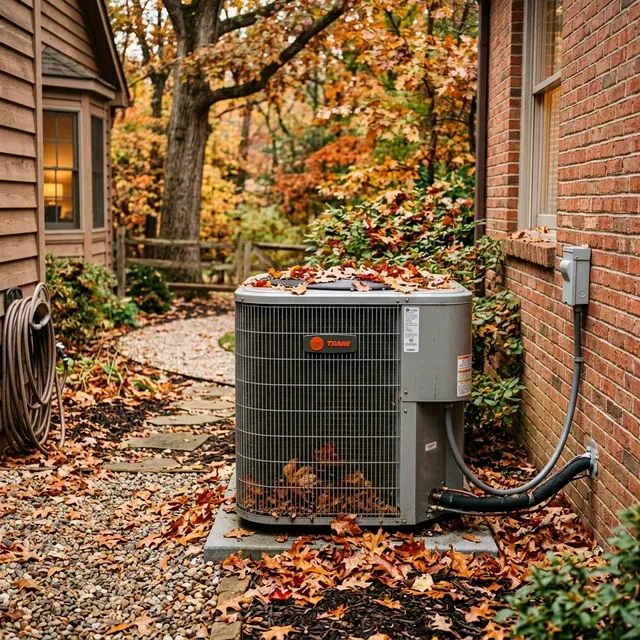
If you have a heat pump or a central AC with an outdoor condenser, clear the area around it after the leaves finish falling. Debris that accumulates through summer and fall can block airflow and, in the case of a heat pump that runs year-round, impair the system's ability to extract heat from cold outdoor air.
- Clear a 2-foot radius of leaves, twigs, seed pods, and encroaching vegetation from all sides of the unit.
- Visually check the condenser fins for bent sections or debris packed into the coil face and note any problems for the technician. Do not attempt to rinse the coil or straighten the fins yourself — the outdoor cabinet contains 240V wiring and these are technician tasks.
- From a safe distance, note whether the foam insulation on the copper lines between the outdoor unit and the house looks cracked or missing. Exposed refrigerant lines lose efficiency and condensation on the suction line can drip and cause water damage where the lines enter the wall — but replacement is a technician task, not a DIY task, because the foam wraps lines that are pressurized with refrigerant and sit alongside live electrical components at the outdoor cabinet. Mention any visible damage to the technician at the fall tune-up.
For a standard central AC (not a heat pump) that will not operate until spring: the outdoor unit is built to sit outside uncovered. If you want a cover, ask the technician at the tune-up which type suits your unit, and never fully wrap it, because trapped moisture can cause corrosion.
For heat pumps: do not cover them. A heat pump runs through winter and requires unrestricted airflow. Instead, keep the clearance zone maintained so defrost cycle drainage and airflow are unobstructed.
7. Find Air Leaks Around Windows and Doors
Every air leak in the building envelope adds to the heat your furnace has to replace, all winter long. Places to check:
- Exterior doors: On a windy day, hold your hand near the frame of a closed exterior door and near the gap at the bottom. If you can feel cold air moving, the weatherstripping or door sweep needs attention.
- Windows: Look where window frames meet the exterior siding for cracked or missing caulk.
- Attic hatch or pull-down stairs: An uninsulated, unsealed attic hatch is an easy-to-miss opening between the living space and the attic.
ENERGY STAR lists weatherstripping doors and caulking around windows among the simple air-sealing fixes, while bigger jobs might include sealing leaks and adding insulation in the attic. This is home-weatherization work rather than HVAC work; a weatherization or home-energy contractor can handle it.
8. Check Your Emergency Heat Source
Fall is the time to prepare your backup plan for what happens if the furnace fails on the coldest night of the year. Having a tested, ready backup prevents a breakdown from becoming a dangerous emergency:
- Electric space heaters: Test each unit now to confirm it heats properly, and do not use one with a frayed or damaged cord. The CPSC advises keeping portable heaters at least three feet from drapes, furniture, bedding, and other combustible materials, and plugging them directly into a wall outlet — never into an extension cord or power strip.
- Wood-burning fireplace: Have the chimney inspected before the first fire of the season; CPSC advises a professional inspection of fireplaces, chimneys, flues and vents each year. A chimney that is cracked, blocked, or coated with creosote is a fire and CO hazard.
- Gas fireplace: Include it in the annual professional inspection of fuel-burning appliances, along with its vent.
- Never use: A gas oven to heat the house, a portable gas camp stove indoors, or a generator inside the home, basement, or garage — even with doors and windows open. The CDC warns against all three because they can produce deadly carbon monoxide.
9. Know Your Shutoff Locations
The middle of a heating emergency — in the dark, in the cold, under stress — is not the time to wonder where things are. Ask the technician to point these out during the fall tune-up, so you can describe them to a dispatcher or emergency crew:
- Gas shutoff at the furnace and the gas meter: Know where they are, but do not operate them. Gas valves and the meter are for the gas utility or a technician to turn.
- Furnace service switch: Usually a light-switch-style switch on or near the furnace or air handler. Knowing what it looks like helps you avoid turning it off by accident; leave switching it and any work at the electrical panel to the technician.
- Main water shutoff: If a pipe freezes and bursts while the heat is out, a plumber or emergency crew will need to find it quickly.
If you smell gas (a rotten-egg or sulfur smell), leave the building right away. Do not flip switches, use phones, light flames, or start a car, and do not try to find the leak or shut off any gas valve or appliance. Once you are outside at a safe distance, call 911 or your gas utility's emergency line, and do not go back in until the utility or emergency responders say it is safe. This is the guidance gas utilities such as Philadelphia Gas Works give; see also our gas leak vs. CO leak guide.
How Much Does Fall HVAC Prep Cost?
The homeowner steps cost little beyond a replacement air filter and fresh CO alarm batteries, which vary by size and brand. The professional side is priced in our HVAC cost guide: a seasonal tune-up runs $80–$200 for one visit, and an annual maintenance contract $150–$350. Compare that with what a breakdown on a cold night adds: a diagnostic or service-call fee of $65–$150, plus $100–$300 for a night or weekend call, before any repair. When you book, ask whether the tune-up includes combustion testing and a heat exchanger inspection.
Connect with a local independent HVAC provider before the heating season rush.
Call Now — (844) 582-1795Disclosure: We are a referral service and may receive compensation for qualified calls. Calls may be routed to an independent provider network and may be recorded. Pricing and availability vary by provider and location.
When Fall Prep Reveals a Bigger Problem
If a fall inspection reveals a confirmed cracked heat exchanger, a disconnected flue pipe, or CO readings above background levels — do not operate the furnace until these are repaired. Use space heaters and extra blankets as a temporary measure. A compromised furnace is a CO risk to your entire household.
Igniter showing high resistance / unusual flame color (yellow or orange instead of blue) / thermostat not communicating with the furnace / the last inspection was more than 12 months ago. These issues warrant a professional visit before winter but are not immediately dangerous if the furnace is not yet running.
With fall prep complete, your next layer of protection is winter-specific — our HVAC winter storm preparedness guide covers freeze protection, power outage backup heating, and what to do when extreme cold hits your home.
Frequently Asked Questions
Schedule in September or early October, before the first freeze. The U.S. Consumer Product Safety Commission advises having a professional inspect fuel-burning heating systems, including furnaces, flues and vents, every year. Booking before cold weather arrives gives you more choice of appointment times, avoids the after-hours fees that apply to night and weekend calls, and leaves time to repair anything the technician finds before you rely on the furnace.
Skipping raises the risk of a breakdown during the coldest weather, when a night or weekend call adds an after-hours fee. More importantly for safety, a cracked heat exchanger or blocked flue vent that goes uninspected can let carbon monoxide into your home during the heating season. An annual inspection gives a technician the chance to find these problems before they become dangerous or expensive.
An outdoor AC condenser is built to sit outside uncovered. If you want to cover one that will not run until spring, ask your technician which kind of cover suits your unit, and never fully wrap it, because trapped moisture can cause corrosion. If you have a heat pump, do not cover it at all: heat pumps run in winter and need full airflow. Keep leaves and debris cleared from around the unit without touching it.
You do not need to operate it, and you should not. Ask the technician to point out the furnace's gas shutoff and your gas meter during the fall tune-up so you can describe them to a dispatcher, but leave any gas valve to the gas utility or a technician. If you smell gas (a rotten-egg or sulfur smell), leave the building right away. Do not flip switches, use phones, light flames, try to find the leak, or shut off any gas valve or appliance. Once you are outside at a safe distance, call 911 or your gas utility's emergency line, as gas utilities such as Philadelphia Gas Works advise.
Setting it lower when you are asleep or away saves energy: ENERGY STAR estimates that a certified smart thermostat, which can make those setbacks automatically, saves about $100 a year in homes with high heating and cooling bills or homes left empty much of the day. During freezing weather, though, the American Red Cross advises keeping the thermostat at the same temperature day and night and, if you will be away, leaving the heat on at no lower than 55°F, to help keep pipes from freezing.
First check the thermostat: it should be set to Heat, the set temperature should be above the current room temperature, and if it uses batteries, try fresh ones. Replace the air filter if it looks dirty, because a severely clogged filter can make the furnace shut itself off. If the furnace still will not run, call for service and do not open the furnace cabinet. If you notice a tripped breaker, leave it off and tell the technician; repeated trips point to an electrical fault. A no-heat problem found on a mild fall day is easier to deal with than one discovered on a freezing night, when an after-hours call adds $100–$300 (see our cost guide).
Connect with a local independent HVAC provider before heating season demand peaks.
Call Now — (844) 582-1795Disclosure: We are a referral service and may receive compensation for qualified calls. Calls may be routed to an independent provider network and may be recorded. Pricing and availability vary by provider and location.
Local HVAC Service Areas
Cool Call Pro connects homeowners with independent HVAC technicians nationwide. Find a pro in Boston (MA), Detroit (MI), Milwaukee (WI), or your city. Browse state HVAC guides: Massachusetts, Michigan, and Wisconsin.