
Advertising Disclosure: This site may receive compensation for service connections made through this page. Content is editorially independent.
A winter storm puts HVAC equipment under unusual stress — ice encasement, debris impact, voltage spikes from restored power, blocked flue vents. The safest homeowner response is to switch the thermostat appropriately (off during a short outage, Emergency Heat for a frozen heat pump) and call a qualified HVAC technician for post-storm inspection. Do not kill the power by going to your service panel to flip the breaker yourself, do not approach the outdoor unit to chip ice, do not pour water on the unit, and do not inspect flue terminations up close. Refrigerant work is federally regulated under EPA Section 608 and certification is legally required. If a CO detector alarms, evacuate first and call 911 — do not attempt to investigate the vents yourself.
Winter storms threaten HVAC systems through blocked exhaust vents, ice-encased heat pumps, power surge damage to control boards, and frozen pipes. Switch the thermostat to OFF during outages and wait 5 minutes after power returns before turning it back on. To protect pipes, keep the heat at the same setting day and night (the American Red Cross says no lower than 55°F if you will be away) and let cold water drip from faucets on exposed pipes in very cold weather.
Ice storms, blizzards, and extended power outages are some of the most stressful events a homeowner can face — and they place severe, simultaneous stress on every component of your HVAC system. Snow can bury exhaust vents. Ice can encase heat pump coils. Surge voltages when power returns can destroy control boards. Pipe failures during a heating outage can cause water damage that costs far more than the original HVAC repair.
The HVAC-related risks — frozen pipes from heating system outages, equipment damage from surge events, and storm debris striking outdoor units — can be costly. Much of that risk can be reduced with the right preparation and the right actions during the storm.
This guide covers what to do before a major winter weather event, during it, and after it passes — organized by both storm phase and system type.
How Do Winter Storms Damage HVAC Systems?
Winter storms create several distinct threats to HVAC equipment. Understanding the mechanism helps you know which steps matter most for your situation:
| Storm Threat | What It Damages | Systems Affected | Prevention |
|---|---|---|---|
| Buried exhaust/intake vents | Furnace shuts down; CO backdraft risk | High-efficiency gas furnaces | Keep snow clear of vent openings; call a technician if buried in ice |
| Ice encasement of outdoor coil | Fan motor burnout; coil damage | Heat pumps | Switch to Emergency Heat during freezing rain |
| Power surge on restoration | Control board, capacitors | All electric HVAC systems | Turn thermostat OFF during outage; wait 5 min after restore |
| Extended heating outage | Frozen and burst water pipes | All systems (secondary risk) | Keep heat on; drip faucets on exposed pipes |
| Storm debris / falling branches | Condenser fins, refrigerant lines | Outdoor AC / heat pump units | Pre-storm clearance; post-storm inspection |
| Floodwater / ice melt intrusion | Electrical components; permanent unit failure | Outdoor units in low-lying areas | Switch system off at the thermostat before water reaches unit |
| Generator CO indoors | Human life safety | All situations with backup power | Never run generators indoors or in garages |
What Are the Storm Risks for Furnaces vs. Heat Pumps?
Your heating system type significantly changes which storm risks apply to you:
Gas or oil furnace: The primary storm risk is exhaust vent blockage. Many high-efficiency furnaces vent through plastic (PVC) pipes that exit through a side wall of the house, sometimes low near the ground, which makes them vulnerable to snow drifts and ice. If the exhaust vent is blocked, the furnace's pressure switch will trip and shut the system down. If the safety systems fail and exhaust backdrafts into the home, CO exposure is the result. After every significant snowfall, look at these vents from a safe distance. If the furnace will not restart after a storm, our complete furnace diagnostic guide explains what each symptom means before you call.
Standard-efficiency furnaces vent through a metal flue pipe and chimney — these terminate high on the roof and are generally less vulnerable to snow burial, though ice damming at the cap and bird nests are still concerns.
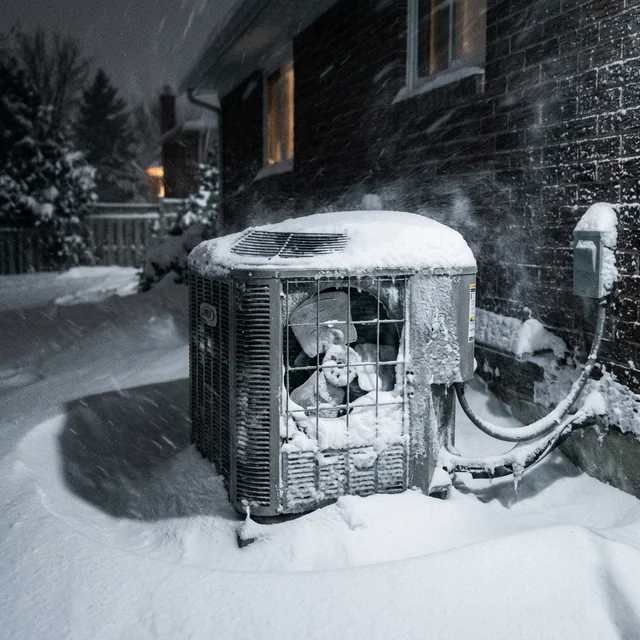
Heat pump: Heat pumps run in winter, extracting heat from outdoor air even at temperatures below freezing. This makes them more exposed to ice storms than furnaces. A heat pump's outdoor unit will frost over during cold, humid weather — this is normal. The unit's built-in defrost cycle handles routine frost. The risk during a severe ice storm is solid ice encasement that the defrost cycle cannot clear fast enough, causing fan blade obstruction and potential motor burnout.
Boiler / radiant heat: Boilers are generally better protected from storm weather than forced-air systems since all the equipment is indoors. The main storm risks are power outages (which stop circulation pumps and can cause pipes in the distribution system to freeze if outdoor temperatures are extreme) and exhaust vent blockage (same as a gas furnace).
1. Keep Exhaust Vents Clear of Snow and Ice
If you have a high-efficiency gas furnace, locate the PVC exhaust and intake pipes on the exterior of your home before winter. Many have two pipes: one for combustion air intake and one for exhaust. They often terminate close together near the foundation — sometimes tucked under a deck, near a window well, or along a wall that can accumulate significant snow drifts.
Before the storm: Ask your HVAC provider about approved vent termination options for your climate. A technician can install protective pipe caps or an extended downward-facing elbow if appropriate for your setup — this is a technician task, not a DIY one, because modifying a gas flue without correct parts and venting calculations creates a carbon monoxide risk and can void combustion safety certification. Do not install or modify vent terminations yourself.
After a heavy snowfall: From a safe distance, observe whether the exhaust and intake pipes are buried. Brushing light, loose snow away from a low, visible vent opening — without touching, knocking, or detaching the pipe — is the limit of what a homeowner should do. Anything involving climbing, chipping ice, pouring water on the pipe, or disturbing the pipe run itself is a technician job. If the vents are deeply buried or encased in ice, call an HVAC technician; do not clear it yourself.
What happens if vents stay blocked: A blocked exhaust triggers the furnace's pressure switch to shut the unit down — you lose heat, but the safety system worked as intended. If somehow the pressure switch fails and exhaust backs up into the home, CO exposure is the result. If your CO detector alarms during or after a heavy snow, evacuate the home immediately, call 911, and call your HVAC provider from outside. Do not re-enter to investigate the vents yourself.
2. Protect the Heat Pump from Ice Encasement
Heat pumps include a defrost cycle that periodically reverses refrigerant flow to melt frost from the outdoor coil. During normal cold weather, you may see steam rising from the outdoor unit during a defrost cycle — this is completely normal operation. The cycle runs periodically for a short time, more often when conditions are cold and humid.
The problem during an ice storm is volume: freezing rain accumulates faster than the defrost cycle can clear it. Signs that ice has outpaced the defrost cycle:
- The entire body of the outdoor unit is encased in solid ice, not just the coil fins
- The fan is making a scraping or grinding sound (ice contacting the blade)
- The system is running in defrost mode continuously without clearing
- Indoor temperatures are dropping despite the system running
What to do: Switch the thermostat to Emergency Heat (some thermostats label it "Em Heat"; check your thermostat's manual for the exact setting). This engages the indoor electric resistance heat strips and allows the outdoor unit to shut down entirely — giving it time to thaw. Once freezing rain stops and outdoor temperatures rise above freezing, switch back to normal heat pump mode.
Thawing a frozen unit: Switching to Emergency Heat and letting the unit thaw naturally as outdoor temperatures rise is the safe homeowner action — the heat pump's own defrost cycle handles most frost, and natural thawing handles the rest. Do not chip ice off the unit, do not pour water on it, and do not approach the unit to interact with it physically. The aluminum fins and refrigerant tubing behind them are thin and fragile, and any close-range intervention is a technician task. If the ice has not cleared within 24 hours of switching to Emergency Heat, call a technician.
3. Manage Power Outages — Protect the Control Board
Modern HVAC systems are controlled by a circuit board that manages the ignition sequence, safety lockouts, and component timing. These boards contain sensitive electronics that are vulnerable to voltage spikes, and Ready.gov warns that when power returns after an outage it "may return with momentary surges or spikes that can cause damage."
Replacing a damaged furnace control board runs $300–$900 for parts and labor in our cost guide. After a widespread storm, when demand for technicians is high, the wait for this repair can be longer than usual — leaving you without heat during the coldest weather.
The simple protection:
- The moment grid power fails, switch your thermostat to OFF.
- Leave it off while power is out.
- When power returns, wait a full 5 minutes for voltage to stabilize before switching the thermostat back on.
- Resume operation and monitor the system for any unusual behavior in the first 15–20 minutes.
For longer-term protection, ask an electrician about a whole-home surge protector installed at the electrical panel and get a written quote. It is worth considering in areas prone to power fluctuations, lightning, or frequent grid instability.
A single long outage followed by stable restoration is less damaging than repeated short flicker-outages where power briefly returns, surges, and cuts again. If your area is experiencing a rolling blackout or unstable grid event with repeated interruptions, keep the thermostat off until power has been stable for at least 5 minutes. Each restoration is a new surge event.
4. Prevent Frozen Pipes When the Furnace Fails
If your heating system fails during a significant freeze, you have a limited window before water pipes in vulnerable areas begin to freeze. A burst pipe is one of the most serious secondary risks of a heating outage — water from a burst pipe can run for hours before anyone notices, and the resulting water damage can cost far more than the heating repair.
According to the American Red Cross, the pipes that freeze most often are those exposed to severe cold, supply pipes in unheated areas such as basements, crawl spaces, attics, garages, and kitchen cabinets, and pipes that run against exterior walls with little or no insulation. There is no single indoor temperature at which pipes freeze: the Red Cross advises keeping the thermostat at the same setting day and night, and if you will be away during cold weather, leaving the heat on at no lower than 55°F.
Immediate actions when indoor heat fails during a freeze:
- Let cold water drip from faucets served by exposed pipes. The Red Cross notes that running water through the pipe, even at a trickle, helps prevent pipes from freezing.
- Open cabinet doors under kitchen and bathroom sinks so warmer room air can circulate around the plumbing. Move cleaners and chemicals out of children's reach.
- Keep interior doors open throughout the home to allow whatever heat remains to circulate evenly rather than isolating in central rooms.
- Use a space heater in the room with the most vulnerable pipes, following its manufacturer's clearance instructions. Never put one inside a cabinet, keep it away from anything flammable, and do not leave it unattended.
- If you must leave the home and cannot restore heat: Call a plumber about shutting off and draining the water system, and make sure you know where your main water shutoff is so a burst pipe can be stopped quickly.
Before winter: insulate exposed pipes in basements, crawl spaces, and garages with foam pipe sleeves. The Red Cross also suggests UL-listed heat tape or heat cable on exposed water pipes; follow the product's installation instructions or have a plumber install it.
5. Generator Safety: The Hidden CO Danger
Many households rely on portable generators for backup power during extended winter outages, and generators produce carbon monoxide. Ready.gov warns that carbon monoxide is a colorless, odorless gas that can kill you, your family, and pets, and that generators must be used outdoors.
Per Ready.gov, generators and fuel should always be used outdoors and at least 20 feet away from windows, doors, and attached garages. Running a generator in a garage — even with the door fully open — can let deadly CO build up and enter the home. There are no safe indoor generator setups. 20 feet outdoors, exhaust directed away from the home. No exceptions.
If you want a generator to run your furnace, have an electrician or HVAC technician set up the connection and confirm the generator is sized for the furnace's running and startup load (listed in the furnace's installation manual). Do not improvise wiring to connect a generator to the furnace.
Working CO detectors with battery backup on every level of the home are essential any time a generator, fireplace, gas oven (used improperly for heat), or any combustion device is in operation. Check detector expiration dates before the winter storm season — see our carbon monoxide safety guide for full placement and replacement guidelines.
6. Book a Post-Storm Professional Inspection
After the storm has passed, book an HVAC technician for a post-storm inspection before relying on the system for sustained heat. Storm damage is often subtle — a slightly bent condenser fin, a shifted flue pipe joint, a partially blocked exhaust vent, or a cracked capacitor from a voltage spike — and these are exactly the failures a homeowner walking around the unit will miss.
What you can safely notice from a distance (describe these to the technician when booking):
- Fallen branches or large debris visibly resting on the outdoor unit
- The unit has obviously shifted, leaned, or tilted off its pad
- A flue pipe is visibly detached, cracked, or hanging loose from the house
- The system sounds different when it runs (new rattles or grinding audible from inside the house)
- Standing water pooled around the base of the unit
What a technician will inspect on arrival — do not attempt any of this yourself because it requires close-range access, opening the outdoor cabinet, or working on gas flue components:
- Condenser fin straightness, coil damage, and debris inside the cabinet
- Refrigerant line insulation condition along the full line run
- All PVC pipe and metal flue terminations for alignment, crack, and proper connection
- Vent caps, screens, and combustion-safety lockouts
- Startup test with amp draw, pressure, and temperature split measurements
First Startup After the Storm
- Turn the system on and listen carefully during the first 10–15 minutes of operation
- Grinding, screeching, or banging sounds that were not present before the storm can indicate storm damage — switch the system off at the thermostat and call for service
- Walk through all rooms and verify that supply vents are delivering warm air — a disconnected duct from ice movement or settling can leave a room without heat
- Check around the furnace and air handler for any water intrusion from melting ice or drainage issues created by the storm
7. Build a Winter Emergency Kit Before Storm Season
The time to assemble your winter emergency kit is before the first storm forecast — not during it. When stores are crowded and shelves are bare is the worst time to discover you need space heaters, batteries, or pipe insulation.
- CO detectors with battery backup on every level of the home (Ready.gov): Essential if you are using any combustion heat source (fireplace, generator, kerosene heater) during an outage. Replace detectors at the age the manufacturer specifies.
- At least one tested electric space heater: Keep it away from anything flammable and follow the manufacturer's clearance instructions. Check the power cord for any damage. Know its wattage so you do not overload a circuit.
- Foam pipe insulation: Pre-cut and installed on exposed pipes in basements, crawl spaces, and garages before winter arrives.
- Extra blankets and warm clothing layers: For the first hours before alternative heat stabilizes indoor temperatures.
- Flashlights for every household member and extra batteries (or a hand-crank light): Ready.gov recommends flashlights for every household member. Use flashlights, not candles, for light during an outage.
- Your furnace model and serial number written down: Tape a note inside a kitchen cabinet or keep it with important documents. When calling for service in an emergency, having this ready helps the technician identify parts before arriving.
- Main water shutoff location marked: Know exactly where it is and confirm it operates smoothly. A shutoff valve that has not been turned in years can be stuck — test it before an emergency.
- Provider contact information on paper: Stored somewhere accessible even if your phone battery dies. Write down the number from this site and at least one local HVAC company's after-hours line.
How Much Does Winter Storm HVAC Damage Cost?
The HVAC repairs a winter storm most often leads to are covered in our HVAC cost guide. The ranges below come straight from it; your technician's written quote is what counts.
| Damage Type | Typical Repair Cost | Notes |
|---|---|---|
| Control board replacement (surge damage) | $300 — $900 | Reduced risk by switching the thermostat off during an outage |
| Capacitor replacement (surge damage) | $150 — $400 | Reduced risk by the same method |
| Condenser coil replacement (debris/ice impact) | $900 — $2,800 | Severity varies; may require full unit replacement |
| Diagnostic / service call (post-storm inspection) | $65 — $150 | Service call to check the system after major weather |
| After-hours emergency surcharge | $100 — $300 | Added to the repair cost for night and weekend calls |
Burst-pipe plumbing and water-damage repairs are outside HVAC pricing; get quotes from a plumber and contact your insurer.
Connect with a local independent HVAC provider for post-storm inspection and repair.
Call Now — (844) 582-1795Disclosure: We are a referral service and may receive compensation for qualified calls. Calls may be routed to an independent provider network and may be recorded. Pricing and availability vary by provider and location.
Urgency Guide: During and After a Storm
If your CO alarm activates during a storm — especially if you are using any backup combustion heat source (generator, fireplace, kerosene heater) — evacuate immediately and call 911. Do not go back in to retrieve belongings. Do not attempt to locate the source. Treat every CO alarm as a genuine emergency.
Furnace not starting after exhaust vents are cleared and the thermostat power cycle procedure is followed / grinding or screeching sounds from the outdoor unit after ice thaws / your heat has failed and freezing weather is forecast. During the storm itself, non-emergency service calls may face significant delays — this is why backup heating and preventive action matter.
Frequently Asked Questions
The moment power goes out, switch the thermostat to OFF. When power returns — even briefly — a voltage spike can damage the furnace or AC control board. Leave the thermostat off for 5 minutes after power is fully restored and stable, then turn it back on. This allows any transient surge to pass and the system to power up under stable voltage.
Normal defrost: a light frost coating on the coil fins during cold weather, with the defrost cycle running periodically (the outdoor unit steams briefly, the system may switch to auxiliary heat for a few minutes). Abnormal icing: solid ice encasing the entire unit body and fan, the unit running in continuous defrost mode without clearing, or the fan blade audibly scraping against ice. If the unit is encased in solid ice, switch to Emergency Heat mode and let the unit thaw — do not chip at the coil.
There is no single indoor temperature at which pipes freeze; the risk depends on insulation, how cold it is outside, and how long the cold lasts. The pipes most at risk run through exterior walls, crawl spaces, attics, garages, and cabinets on outside walls. The American Red Cross advises keeping the thermostat at the same temperature day and night, and if you will be away during cold weather, leaving the heat on at no lower than 55°F. In very cold weather, let cold water drip from faucets served by exposed pipes. If your heat has failed and freezing weather is forecast, call for service right away.
No — never. Ready.gov says generators should always be used outdoors and at least 20 feet away from windows, doors, and attached garages, so a garage is never a safe place to run one, even with the door open. Carbon monoxide is colorless and odorless and can kill. Point the exhaust away from the home, and install working carbon monoxide detectors with battery backup on every level of your home.
There is no set wait time. It depends on how widespread the storm is, road conditions, and how many technicians are available in your area, and non-emergency repairs can take longer than usual after a major storm. If a CO alarm sounds or you smell gas, leave the home and call 911 or your gas utility from outside first. This is why fall maintenance and a tested backup heat source matter — storm season is the worst time to discover a failing furnace.
Yes. If floodwater or snowmelt is approaching the outdoor unit, switch the system off at the thermostat. Do not walk into water near the unit or go to its electrical disconnect or the breaker panel. If water is already near electrical equipment, stay away and call your electric utility or an electrician. Water in capacitors, contactors, and control boards can cause permanent failure and creates an electrocution hazard. Do not restart the system until an HVAC technician has inspected and cleared the outdoor unit after any flood event.
Connect with a local independent HVAC provider for inspection and repair.
Call Now — (844) 582-1795Disclosure: We are a referral service and may receive compensation for qualified calls. Calls may be routed to an independent provider network and may be recorded. Pricing and availability vary by provider and location.
Local HVAC Service Areas
Cool Call Pro connects homeowners with independent HVAC technicians nationwide. Find a pro in Detroit (MI), Boston (MA), Milwaukee (WI), or your city. Browse state HVAC guides: Michigan, Massachusetts, and Wisconsin.