
Advertising Disclosure: This site may receive compensation for service connections made through this page. Content is editorially independent.
If your AC is coming out of winter and you noticed weak airflow, odd smells, or it just isn't cooling right yet, the safe homeowner spring-prep list is narrow: replace the air filter, flush the condensate drain with vinegar, and clear loose debris from around (not touching) the outdoor unit. Everything else in this guide — coil cleaning, refrigerant pressure check, capacitor test, temperature-split measurement — is what a technician performs during a professional tune-up. Do not kill the power by going to your service panel to flip the breaker yourself, do not open the outdoor cabinet, and do not operate the outdoor disconnect. Refrigerant work is federally regulated under EPA Section 608 and certification is legally required.
If your AC has been sitting through winter and you noticed weak airflow, odd smells, or an unusual sound the first time it ran this season, the safe homeowner spring-prep list is narrow but specific. Work through 7 spring AC prep steps in March or April, before the first 80°F day: replace the filter, have a technician clean the outdoor condenser, flush the condensate drain with vinegar, look over the refrigerant line insulation without touching it, let a technician test the system, switch the thermostat to Cool, and book a professional tune-up ($80–$200 in our cost guide). Worn parts found in spring get fixed at a scheduled visit instead of on a hot weekend, when an after-hours fee is added.
The worst time to find out your central air conditioner has a problem is the first hot weekend of summer — a day when temperatures spike, local HVAC companies are busy, and a same-day appointment may be unavailable or billed with an after-hours fee. The system that worked fine the previous September has sat idle through fall and winter. Capacitors wear, condensate drains can clog with algae, and condenser coils collect a season's worth of debris. On the first truly hot day, a small issue like these can turn into a no-cooling call.
Spending an hour in March or April on the homeowner steps below — and booking a technician for the rest — gives you the chance to find these problems before a heat wave does. ENERGY STAR makes the same point: contractors get busy once summer arrives, so it recommends checking the cooling system in the spring.
Why Should I Service My AC in Spring, Not Summer?
March and April represent a narrow window where several conditions align in your favor:
- Appointments are easier to get at standard rates. Contractors get busy once summer comes, per ENERGY STAR. A spring tune-up is a scheduled visit; a mid-summer breakdown on a night or weekend adds an after-hours fee ($100–$300 in our cost guide) to the repair.
- You can test the system without actually needing it. On a mild spring day, you can run the AC to verify it works — and if it does not, you have days or weeks to schedule a repair before the heat forces your hand. Discovering a failed capacitor in April means a routine repair call at your convenience. Discovering it during a July heat wave can mean waiting for an opening, or paying an after-hours fee on top of the repair.
- Condensate drain clogs are easier to clear before season. Algae and mold that grew in the drain line over winter are easier to flush out in spring before the system starts running continuously and backs up into the drain pan — which, if not caught, overflows onto your ceiling or floor.
- Efficiency improvements compound over the season. A clean condenser coil, a fresh filter, and properly insulated refrigerant lines each contribute a small efficiency gain. ENERGY STAR notes that dirty coils make the system run longer and a dirty filter can increase energy costs, so starting the season clean helps keep cooling bills down.
In Texas, Florida, Arizona, and the Southeast, cooling season can arrive in earnest by late March or early April. If you live in a climate where you run the AC before Memorial Day, move your spring prep to February — the logic is the same but the timeline is compressed.
What Does a Spring AC Prep Schedule Look Like?
| Step | Best Timing | DIY or Pro | Time Required |
|---|---|---|---|
| Replace air filter | Before first use | DIY | 5 minutes |
| Outdoor condenser coil cleaning | At the spring tune-up | Pro | Part of the tune-up |
| Vinegar flush of condensate drain line | March–April | DIY | About 30 minutes (mostly waiting) |
| Look over refrigerant line insulation (no touching) | March–April | Look only; a pro repairs it | A few minutes |
| Switch to Cool and confirm it runs; technician measures performance | On a mild-to-warm day | Thermostat: DIY; tests: Pro | Part of the tune-up |
| Update thermostat settings | Before cooling season | DIY | A few minutes |
| Professional tune-up | March–April (book early) | Pro | Varies by system |
1. Replace the Air Filter
Start every cooling season with a fresh air filter — regardless of when the last one was installed. A filter that has been in place since late fall has collected debris from heating season. If you run a gas furnace through the filter, the same filter handles cooling too, and it has been collecting dust for months.
A clogged filter at the start of cooling season has two direct consequences. First, restricted airflow starves the evaporator coil of the warm return air it needs to absorb heat — the coil gets too cold, the condensate on its surface freezes, and the frozen coil blocks airflow entirely. A dirty filter or blocked return vents are one possible cause of a frozen evaporator coil. Second, according to ENERGY STAR, a dirty filter can increase energy costs and damage your equipment, leading to early failure.
Replace the filter at the start of the season, then follow ENERGY STAR's advice to inspect, clean, or change it once a month and the filter maker's replacement interval. Homes with pets or a lot of dust may find the filter dirty sooner. Write the installation date on the filter's cardboard frame so you always know how old it is.
A higher MERV rating traps more small particles. The EPA suggests choosing at least MERV 13 if you upgrade, "or as high a rating as your system fan and filter slot can accommodate," and notes you may need an HVAC technician to determine the highest-efficiency filter that works for your system. Check your system's documentation or ask the technician at your tune-up what rating fits your air handler.
2. Have a Technician Clean the Outdoor Condenser Unit
The outdoor condenser unit has spent the winter collecting leaves, dirt, cottonwood seeds, dead grass, and whatever else the weather brought. The condenser coil — the fins wrapped around the outside of the unit — is how your system dumps heat to the outdoor air. A dirty coil means the system has to work harder and run longer to move the same amount of heat, raising your electricity bill and straining the compressor.
Coil cleaning is a technician task, not a DIY project. The outdoor cabinet contains high-voltage wiring and a capacitor that can hold an electrical charge, and proper cleaning calls for coil cleaner, fin tools, and an inspection of the refrigerant circuit. The technician will shut off power at the disconnect, inspect for pest damage or fin bending, apply the correct cleaner, and rinse the coil at the correct pressure — steps that are unsafe for a homeowner to attempt because they require opening access panels.
What you can safely do as a homeowner before the visit:
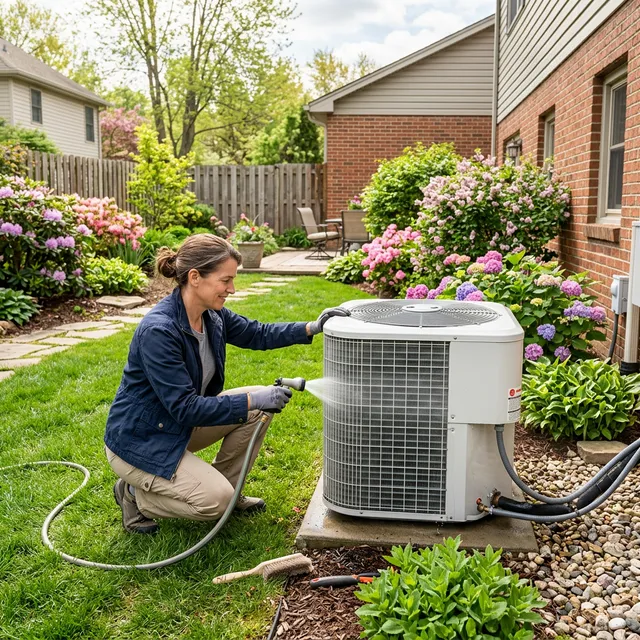
- Clear loose debris from around (not touching) the outdoor unit. Pick up leaves, branches, and stored items around the unit so air can move freely. Do not spray the unit with water. Do not touch the outdoor disconnect. Do not open the cabinet or the top grille.
- Book a spring tune-up instead of attempting coil cleaning yourself. ENERGY STAR's check-up list includes cleaning the evaporator and condenser coils, checking the refrigerant level, testing electrical connections, and inspecting the condensate drain. Refrigerant work legally requires an EPA-certified technician. A tune-up runs $80–$200 in our cost guide.
Air conditioners have a minimum outdoor temperature for cooling operation, set by the manufacturer. Check the owner's or installation manual for your unit's limit and do any spring test on a mild-to-warm day above it. If you are not sure, leave the startup test to the technician at your tune-up.
3. Clear the Condensate Drain Line
When your AC removes humidity from indoor air, the moisture condenses on the evaporator coil and drips into a drain pan, then flows out through a condensate drain line — typically a white PVC pipe that exits near the air handler and drains to a floor drain, outside, or into a condensate pump. Over winter (and throughout a wet cooling season), algae and mold grow inside the drain line. The warm, moist, dark environment is ideal for biological growth, and it can reduce the line's flow rate enough to cause a backup.
A backed-up condensate drain overflows the drain pan. In attic air handlers, that water falls through the ceiling. In basement or closet units, it puddles on the floor. Many systems have a float switch in the drain pan that shuts down the system when water reaches a certain level — but by then, the water has already backed up significantly.
A spring vinegar flush can help keep the line clear:
- Locate the condensate drain clean-out — usually a T-shaped fitting with a removable cap on the PVC pipe near the air handler.
- Turn the thermostat off, then pour one cup of distilled white vinegar into the clean-out.
- Wait 30 minutes, then flush with a cup of clean water.
- Check the drain outlet (outside or at the floor drain) to confirm water is flowing freely.
If the line is already blocked — water standing in the clean-out, water in the pan, or the system shut off by its float switch — stop at the vinegar flush and call a technician. Clearing a hard clog is a technician job: they can clear the line with the right equipment or find a broken section of pipe. See our guide to HVAC water leaks inside the house if water is already on the floor or ceiling.
Connect with a local independent HVAC technician before summer demand peaks. Spring appointments are faster, cheaper, and easier to schedule.
Call Now — (844) 582-1795Disclosure: We are a referral service and may receive compensation for qualified calls. Calls may be routed to an independent provider network and may be recorded. Pricing and availability vary by provider and location.
4. Inspect Refrigerant Line Insulation
Two refrigerant lines run between your outdoor condenser unit and the indoor air handler — a smaller liquid line and a larger suction line. The suction line carries cold, low-pressure refrigerant vapor back to the compressor and must be insulated to prevent it from absorbing heat from the surrounding air before it reaches the compressor. Proper insulation also prevents the line from sweating (condensing moisture from the air), which can damage walls, ceilings, and the line itself over time.
From a safe distance (not touching the lines, not approaching the outdoor cabinet), note whether you can see:
- Sections where the foam insulation has visibly cracked, collapsed, or fallen away
- Gaps at fittings and joints where insulation has shrunk back
- Discoloration or moisture staining on walls or ceilings below where the lines run
Foam insulation replacement on refrigerant lines is a technician task — the foam wraps pressurized refrigerant lines that sit alongside live electrical components at the outdoor cabinet. Mention any damage you notice to the technician at the spring tune-up so they can replace it during the visit. Do not attempt to wrap or replace the foam yourself.
5. What a Technician Tests During the Spring Tune-Up
A professional spring tune-up includes a comprehensive system test you should not attempt to do yourself. The technician has the tools, training, and access privileges to safely measure refrigerant pressures, temperature split, amperage draw, and other diagnostics that require opening the outdoor cabinet or working near live components.
Here is what the technician will check so you can confirm they are doing the job thoroughly:
- Thermostat cool-mode startup. Set to Cool, a few degrees below indoor temperature, to confirm the system starts, runs, and shuts off properly.
- Temperature split (Delta T) measurement. The technician uses calibrated probes at the supply vent and return grille. They compare the reading with the range expected for your equipment. A split that is too low can point to refrigerant, airflow, or coil problems; one that is too high can point to severe airflow restriction. Do not try to measure this yourself — a consumer thermometer at a register is not reliable and exceeds the homeowner-DIY cap.
- Refrigerant pressure gauges. High-side and low-side readings confirm charge level without needing to physically feel the lines.
- Capacitor microfarad test. A multimeter at the outdoor cabinet (after the technician shuts off power at the disconnect and safely drains the capacitor) confirms whether the capacitor still measures within the tolerance printed on its label.
- Compressor and fan motor amp draw. A clamp meter on the leads verifies each motor is within spec.
- Coil inspection and cleaning. Only accessible with the cabinet open — never a homeowner task.
What a homeowner can safely notice without approaching the unit: whether the system sounds "different" than last year (new rattles or grinding heard from inside the house), whether supply air smells persistently musty (suggests coil biofilm), and whether the system takes noticeably longer to reach set point than it did last summer. Describe what you observed; let the technician diagnose. If the system is not cooling at all, our complete AC troubleshooting guide walks through what each symptom can mean and when to call.
Ice forming on the refrigerant lines or on the outdoor unit while the AC is running is not normal. It points to a problem such as low refrigerant or restricted airflow, and running the system that way can damage it. Turn the system off at the thermostat, let the ice melt completely, and call a technician before running it again. Our guide to an AC freezing up in summer explains the causes.
6. Update Thermostat Settings for Cooling Season
Before the heat arrives, take 10 minutes to verify your thermostat is configured correctly for cooling season. This is especially easy to overlook on programmable and smart thermostats that have separate schedules for heating and cooling.
- Switch from Heat to Cool (or Auto). Many programmable thermostats require manually switching the system mode. If left in Heat mode, the thermostat will not activate the AC regardless of temperature.
- Update the programmed schedule. Summer occupancy patterns are different from winter ones — work-from-home days, vacation weeks, different wake and sleep times. Update the schedule now so you are not running the AC on a heating-season program that doesn't match your actual summer routine.
- Set the correct temperature targets. Set the temperature higher when you are asleep or away; ENERGY STAR notes that smart thermostats can learn your schedule and make those adjustments automatically. For households with heat-sensitive members, set comfort as the priority — but know the efficiency trade-off.
- Verify smart thermostat settings. If you have a smart thermostat, confirm that geofencing and occupancy detection are functioning correctly. Check the app or the manufacturer's instructions for any system alerts or seasonal settings.
7. Schedule a Professional AC Tune-Up
The DIY steps above address what you can see and access. A professional tune-up covers everything else — and the "everything else" is where the most consequential problems hide.
Here is what a thorough professional AC tune-up should include:
- Refrigerant level check and leak inspection: Low refrigerant can reduce cooling capacity, and ENERGY STAR notes that too much or too little refrigerant makes a system less efficient. Anyone handling refrigerant must be Section 608-certified under EPA rules — this is not a DIY task. More importantly, a technician will check why the level is low, since refrigerant does not simply "run out" — low refrigerant means there is a leak that needs to be located and repaired before recharging.
- Capacitor and contactor testing: The run capacitor stores electrical charge that helps start and run the compressor and fan motors. Capacitors wear over time — measuring capacitance identifies ones that still work but read below their rating. Replacing a weak capacitor at a scheduled visit ($150–$400 installed in our cost guide) avoids adding an after-hours fee if it fails on a July weekend. The contactor (an electrical relay) is checked for pitting and arcing.
- Evaporator coil inspection and cleaning: The indoor evaporator coil can develop mold and debris accumulation that restricts airflow and creates a musty odor. A technician cleans it with a foaming coil cleaner that cuts through biological buildup without damaging the fins.
- Electrical connection check: Loose wiring connections cause resistance and heat. Tightening connections during a tune-up is standard practice and prevents failures caused by arcing or overheated terminals.
- Blower motor and belt inspection: The technician checks blower motor amperage draw (elevated draw means a struggling motor), checks bearings, and lubricates as needed.
- Delta T measurement: The technician measures the temperature difference between supply and return air. If it falls outside the expected range for the equipment, they can look for the cause — low refrigerant, a dirty coil, or an airflow restriction.
A professional AC tune-up costs $80–$200 per visit in our cost guide, and ENERGY STAR recommends a pre-season check-up every year. For an older system, a tune-up also gives you a professional assessment of its condition — useful if you are deciding whether to invest in repairs or plan for replacement. See our guide to refrigerant costs and regulations if your system uses R-22 or R-410A refrigerant.
How Much Does a Spring Tune-Up Save vs. Summer Emergency?
The same repair costs about the same whether it happens in April or July — the difference is whether it lands on a scheduled weekday visit or an after-hours emergency call. Ranges below come from our cost guide:
| Problem | Caught at a Spring Visit | Same Repair After Hours in Summer | Difference |
|---|---|---|---|
| Failing capacitor (caught in tune-up) | $150–$400 | $150–$400 + after-hours fee | +$100–$300 |
| Low refrigerant (recharge after the leak is repaired) | $150–$600 | $150–$600 + after-hours fee | +$100–$300 |
| Condensate drain clog (flushed in spring) | Vinegar flush (DIY) or $75–$250 (pro) | $75–$250 + after-hours fee + any water damage | +$100–$300, plus any water damage |
| Professional tune-up (preventative) | $80–$200 | Not applicable | Finds worn parts before they fail |
| After-hours emergency dispatch fee | Not applicable | +$100–$300 | Avoided entirely |
If a tune-up catches one failing part before it quits on a weekend, the after-hours fee it avoids can offset much of the tune-up's cost.
If you are weighing repair costs against system replacement for an older AC unit, see our guide to summer AC repairs and warning signs for a breakdown of what each common repair actually costs.
Spring availability fills up fast. Get connected with a local independent HVAC provider now — before the summer rush makes scheduling difficult.
Call Now — (844) 582-1795Disclosure: We are a referral service and may receive compensation for qualified calls. Calls may be routed to an independent provider network and may be recorded. Pricing and availability vary by provider and location.
Frequently Asked Questions
Spring. ENERGY STAR recommends checking the cooling system in the spring, before contractors get busy in summer. March through April works well across much of the U.S. — temperatures are mild enough that you can test the system without needing it for comfort, and HVAC technicians are not yet slammed with summer emergency calls. In the South and Southwest (Texas, Florida, Arizona, Georgia), push that window to late February or March since cooling season arrives earlier. The goal is to be fully prepared before the first stretch of consistent 80°F+ days.
A homeowner can safely replace the air filter, clear loose debris from around (not touching) the outdoor unit, flush the condensate drain line with vinegar, and turn the thermostat to cooling mode to test it. Everything else — coil cleaning, refrigerant handling, electrical testing, fin work, anything that requires opening the outdoor cabinet or the service panel — is a technician task. A professional spring tune-up ($80–$200 in our cost guide) is the safe way to prep the system each year.
A standard professional tune-up includes: refrigerant level check and leak inspection, capacitor and contactor condition testing, evaporator and condenser coil inspection and cleaning, electrical connection tightening, blower motor amperage check and lubrication, thermostat calibration verification, and Delta T measurement. A good technician will also note anything approaching end of service life so you can plan — rather than be surprised — by upcoming repairs.
Common signs include the system running longer than usual without reaching the set temperature, warm air from supply vents when the AC is running, ice forming on the refrigerant lines or evaporator coil, a hissing or bubbling sound near the unit, or a noticeable increase in your electricity bill without a change in usage. If you notice any of these, turn the system off and call a technician — a refrigerant leak must be found and repaired before recharging. Simply adding refrigerant without fixing the leak is a temporary and expensive non-fix.
ENERGY STAR advises inspecting, cleaning, or changing the air filter once a month, and the EPA says to follow the filter manufacturer's replacement recommendations. Replacement intervals differ between thin 1-inch filters and thicker media filters, so check the packaging or your system's manual. The simple rule: if the filter looks gray and dense when you pull it out, replace it regardless of how long it has been installed.
Local HVAC Service Areas
Cool Call Pro connects homeowners with independent HVAC technicians nationwide. Find a pro in San Antonio (TX), Birmingham (AL), New Orleans (LA), or your city. Browse state HVAC guides: Texas, Alabama, and Louisiana.