
Advertising Disclosure: This site may receive compensation for service connections made through this page. Content is editorially independent.
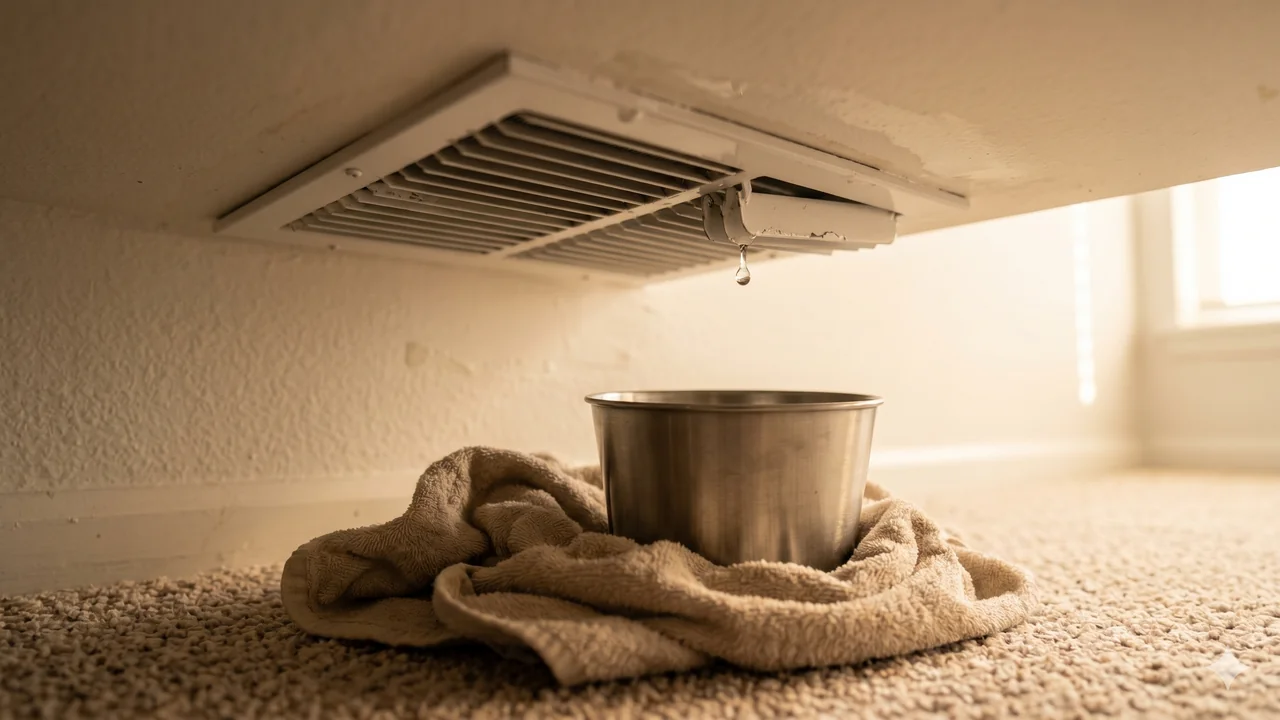
If your ceiling vent is dripping water, the water is coming from something upstream that has overflowed — a clogged condensate drain, a frozen coil that thawed, or duct insulation that has failed in a humid attic. Do three things in this order: (1) set the thermostat to OFF to stop the system from producing more condensation, (2) put buckets and towels under every active drip to contain the damage, (3) call a qualified HVAC technician same-day. Every hour of continued drip is ceiling drywall, flooring, and possibly drywall ceiling collapse. Do not open the air handler, do not climb into the attic to inspect, and do not try to kill the power by going to your service panel to flip the breaker — just the thermostat off is enough. If you see a visible ceiling bulge above the drip, keep everyone out of that area; a pooled ceiling can collapse suddenly.
Water dripping from an AC vent is a water-damage-in-progress event. Ceiling drywall soaks, flooring warps, and EPA advises drying water-damaged areas within 24–48 hours to prevent mold growth. Treat this as a same-day HVAC call, not a "book next week" problem. Set the thermostat to OFF, catch the water with buckets, and call a qualified HVAC technician. Do not kill the power by going to your service panel to flip the breaker — just the thermostat off is enough and avoids panel operation entirely. Do not climb into the attic to inspect — wet attics are slip hazards, the air handler contains live high-voltage wiring, and you cannot safely diagnose the root cause from there. Do not touch any electrical fixture (ceiling light, fan) in the dripping area. If you see water pooling in the ceiling above the drip (drywall bulging or sagging), keep everyone out — a pooled ceiling can collapse. Refrigerant work, if the evaporator coil is implicated, is federally regulated under EPA Section 608 and certification is legally required.
Where the Water Is Actually Coming From
Air conditioning cools indoor air by running it across a cold evaporator coil inside the air handler. Humidity in the air condenses on the coil — that is a feature, not a bug, and it is how your AC also dehumidifies the house. Normally, that condensation drips into a drain pan directly under the coil and flows out through a small white PVC drain line that exits the house through an exterior wall or drains to a floor drain or condensate pump.
In humid weather the AC pulls a steady stream of water out of your indoor air. When the drain path works, you never see a drop. When something blocks that path or diverts the water, it has to go somewhere — and the path of least resistance is usually the duct system that carries cooled air to your vents. Water reaching a vent is always a sign the normal drain path has failed upstream.
The 5 Causes of Water from a Ceiling Vent
1. Clogged Condensate Drain Line
The PVC drain line runs from the air handler to an exterior wall or a floor drain. A clogged or dislodged drain line is one of the condensate-overflow causes ACCA lists: bacteria and fungus build up inside the line until it blocks. When the line fully clogs, water backs up into the drain pan, overflows the pan, and falls onto the ductwork or sheet metal below — eventually traveling to the nearest supply vent and dripping out. If your system has a float (overflow) switch, it shuts the AC off when the pan fills, but it does not stop water that has already overflowed. A technician clears the drain (vacuum at the outdoor end, vinegar flush from the cleanout), resets the float switch, and confirms the pan is draining freely. Homes in humid climates such as San Antonio and Tallahassee run long cooling seasons, so the drain line carries condensate for more of the year. For the related water-everywhere symptom, see our full guide on how to stop HVAC water leaks before they ruin drywall and flooring.
2. Frozen Evaporator Coil That Thawed
When the evaporator coil ices over (for example from a dirty air filter or low refrigerant), the ice eventually thaws either because the system shut down or because a technician turned it off. As ACCA explains, when that ice melts into the drain pan, the pan can overflow from the excess volume. The overflow follows the same path to the vents. This pattern often overlaps with cause 1: a clogged drain that pushes the coil into freezing in the first place. For the full freeze-thaw diagnosis, see our guide on AC freezing up in summer.
3. Missing or Damaged Duct Insulation (Attic Systems)
If your air handler lives in an attic or a crawl space with humid, uncooled ambient air, the cold supply ducts are wrapped in foam or fiberglass insulation to prevent humid attic air from condensing on the cold metal surface. When that insulation cracks, compresses, or falls away, moisture condenses directly on the outside of the duct — drips off, soaks the ceiling drywall below, and eventually emerges at the nearest vent. The fix is duct insulation repair or replacement, a technician task.
4. Cracked or Disconnected Drain Pan
The primary drain pan sits directly under the evaporator coil; a secondary (emergency) pan sits under the air handler in attic installations. Pans crack with age (plastic) or rust through (galvanized metal). A cracked primary pan dumps condensate through its floor, straight onto the cabinet below. A disconnected drain-pan-to-line fitting does the same. Both are technician repairs; the pan itself is not expensive but access through the cabinet requires opening access panels near live electrical.
5. Disconnected Duct Joint Letting Humid Attic Air Into the Supply Flow
Supply ducts joined at a plenum or junction can come apart over years — from thermal cycling, animals, or rough installation. A loose joint lets humid, warm attic air leak INTO the supply duct where it meets the cold conditioned air. That mixing condenses moisture on the inside of the duct, which then runs out the nearest vent. This is a harder problem to diagnose because the drain pan looks fine; a technician with a smoke pencil and an understanding of your duct layout is needed.
Get connected with a technician in your ZIP code.
Call Now — (844) 582-1795Disclosure: We are a referral service and may receive compensation for qualified calls. Calls may be routed to an independent provider network and may be recorded. Pricing and availability vary by provider and location.
What to Ask the Dispatcher (and Red Flags to Watch For)
When you call, ask the dispatcher to confirm: (1) the diagnostic service-call fee in writing before dispatch (typical range $65-$150 per our cost guide), (2) how you can confirm the technician holds any license your state requires (check it yourself at your state regulator's license lookup) and carries insurance, and (3) the quote will itemize parts and labor before any work proceeds. Red flag: any dispatcher who pushes "full air handler replacement" on a drain-line symptom without first inspecting the drain line itself — a competent diagnostic checks the drain line first ($75-$250 to clear) before recommending a larger repair. If the first quote feels disproportionate to the symptom, get a second opinion before authorizing.
What You Can Safely Do Right Now
The safe homeowner actions on this symptom are narrow but time-sensitive. Do them in order.
- Set the thermostat to OFF. This stops the system from producing more condensation and the drip rate drops within minutes. No electrical work involved, no approach to the air handler. This is the single most valuable action you can take to limit water damage.
- Put buckets and towels under every dripping vent. Walk the house. Any vent that is actively dripping or has visible water staining gets a bucket or large bowl underneath, with old towels around the perimeter to catch splashes. A plastic tarp or drop cloth on the floor helps if you have one. Move electronics, paper, art, and valuables out of the drip path.
- Check the ceiling for bulging above the drip. If you see the drywall ceiling bulging or sagging, water is pooling on top of it. A pooled ceiling can collapse suddenly under the weight. Keep everyone out of that area. Do not poke or drill into it; mention the bulge on the call so the technician (or a water-damage restoration company) can deal with it safely.
- Call a qualified HVAC technician same-day. Every hour of drip compounds ceiling damage and accelerates mold risk. Describe exactly what you see: which vent, how fast the drip, whether there is a ceiling bulge, whether the system has been running in heavy use recently (heat wave, guests, etc.). If you cannot get a same-day call, your second call is to a water-damage restoration company to prevent the mold cascade.
Do NOT do any of the following — every one either wastes time or creates a new hazard:
- Flip the AC breaker at your service panel. Thermostat off is enough; the breaker does not need operating.
- Climb into the attic or crawlspace to inspect. A wet attic is a slip hazard, the air handler sits alongside live high-voltage wiring, and the diagnosis requires tools you do not have.
- Open the air handler access panel. Capacitors inside the cabinet can hold a dangerous electrical charge even with the power off.
- Touch any ceiling light, ceiling fan, or electrical fixture in the dripping area. Water plus electricity is a shock and fire risk — leave those fixtures off until the technician has cleared them.
- Snake the drain, use a wet-vac on it, or pour bleach into it. Clearing an active clog is a technician job. (A white-vinegar flush of the drain line is fine as routine prevention; Trane suggests asking your technician to show you how to pour a cup of distilled vinegar down the line. It will not stop an overflow that is already happening.)
- Restart the AC after the drip stops, thinking the problem is gone. The underlying cause is still there; the water will come back.
When to Stop and Call a Professional (and How Urgently)
Short answer: call now. The condition is worsening on the clock. Specific patterns that make it more urgent:
- Water is dripping from more than one vent or across multiple rooms. The drain overflow or duct issue is extensive; ceiling damage is compounding fast.
- You see a visible ceiling bulge anywhere the water is pooling. A collapse is possible; keep people and pets out of the area.
- The drip reaches a ceiling light fixture, ceiling fan, or smoke detector. Stay away from the fixture and the water, do not touch its switch, and call a qualified electrician alongside the HVAC technician.
- The drip started after a heat wave. Mention this on the call: a coil that iced over and then thawed is one of the causes the technician will want to rule out.
- The drip smells musty or contains visible gray/black material. Mold may already be growing. Keep clear of the affected area and surface this during the technician's diagnosis.
- The system is in an attic. An overflow there drains through the ceiling into the living space below.
For the full map of every AC failure mode and how they connect, see our complete AC troubleshooting guide. If the underlying cause turns out to be a frozen coil, our guide on AC freezing up in summer covers the full thaw procedure. If the thermostat also went blank when the float switch tripped, read thermostat blank, AC won't turn on. For the broader water-leaks-indoors picture, see how to stop HVAC water leaks before they ruin drywall and flooring.
What a Technician Will Actually Check
A thorough diagnosis walks the whole condensate path and checks the duct system:
- Drain line flow test. The technician pours water into the cleanout and confirms it flows freely out the exterior end. Slow flow or no flow indicates a clog; technician-grade drain clearing (wet-vac at the outdoor end, nitrogen blowout, or enzyme treatment) clears it.
- Drain pan inspection. Opening the air handler access panel (a technician-only step because of adjacent live electrical components), the technician inspects both the primary pan for cracks, and the secondary (emergency) pan on attic installations.
- Float switch operation. Confirming the switch interrupts the 24V signal correctly when the pan fills — and resetting it after the drain is cleared.
- Evaporator coil inspection. Looking for ice accumulation or recent ice damage, biofilm buildup that could have restricted drain flow, and fin condition.
- Duct insulation inspection (attic or crawl space systems). Walking the duct runs to identify cracked or missing insulation that would let humid air condense on a cold duct surface. This is the diagnosis for the harder "where is the water coming from if the drain is fine?" cases.
- Refrigerant charge check. Low refrigerant is one possible upstream cause of a coil freeze that leads to an overflow. Refrigerant-side work is federally regulated — see the safety warning above.
What Repairs Cost in 2026
Pricing on this site is anchored to our complete 2026 HVAC Cost Guide, which is the single source of truth for every cost figure — no drift between articles.
- Diagnostic / service call: $65–$150 (ask whether it is credited toward the repair)
- Drain pan / condensate line repair (incl. clearing the line and resetting the float switch): $75–$250
- Duct insulation repair: not listed on our cost guide; ask for an itemized quote
- Evaporator coil replacement (if compromised): $600–$2,000
- Emergency / after-hours surcharge: $100–$300 added
Ranges from our 2026 HVAC cost guide (Cool Call Pro editorial estimates). Actual costs vary by region, provider, and system.
The ceiling-repair side can cost more than the HVAC fix: drywall patch and paint, flooring if water reached it, and mold remediation if wet materials were not dried in time. EPA advises drying water-damaged areas and items within 24–48 hours to prevent mold growth. That is why speed matters — a same-day HVAC call keeps the water-damage cost contained.
Climate Matters: Where This Shows Up Most
Hot-humid climates (San Antonio, Tallahassee, the Gulf Coast): Long, humid cooling seasons mean the drain line carries condensate for months, so drain-line clogs and failed duct insulation in attic installations are the causes to check first. Ask your technician to include the condensate drain in the spring tune-up; ENERGY STAR's maintenance checklist notes that a plugged drain can cause water damage in the house.
Hot-dry climates (El Paso, Phoenix, Las Vegas): Drier air means less condensate, so besides the drain line, a frozen coil that thawed (for example in a system low on refrigerant) is a cause to rule out — the meltwater can overflow a drain pan sized for normal condensate.
Mixed-humid climates (Charleston, St. Louis, Cincinnati): Any of the five causes can apply — duct condensation on humid spring days, drain clogs in peak summer, and frozen-coil thaws. Browse local service providers in Texas, Florida, or explore all service areas.
Trusted Industry Sources
The guidance in this article is consistent with published recommendations from:
- U.S. Department of Energy — Purchasing Energy-Efficient Central Air Conditioners
- EPA Section 608 — Refrigerant Handling Regulations
- EPA — Mold Cleanup in Your Home
- ENERGY STAR Heating & Cooling
Don't wait — get a technician dispatched to your area.
Call Now — (844) 582-1795Disclosure: We are a referral service and may receive compensation for qualified calls. Calls may be routed to an independent provider network and may be recorded. Pricing and availability vary by provider and location.
Frequently Asked Questions
The water is condensation that your AC produces as it cools humid indoor air. Normally it flows into a drain pan under the evaporator coil and out through a PVC drain line. When you see water at a supply vent, something upstream has overflowed or condensed in the wrong place. Five possible causes: a clogged condensate drain line, a frozen evaporator coil that thawed and overwhelmed the drain, missing or damaged insulation on a supply duct in a humid attic (cold duct + humid air = condensation on the outside of the duct), a disconnected or cracked drain pan, or a disconnected duct joint letting humid attic air into the supply airflow. All five are technician repairs.
The water itself is just condensation — it is not a contamination hazard in the short term. The danger is what it does to your home. Water soaking into ceiling drywall causes the drywall to swell, stain, and eventually sag. Water reaching electrical components (recessed lighting fixtures, wiring) creates a shock and fire hazard. EPA advises drying water-damaged areas and items within 24 to 48 hours to prevent mold growth; mold is both a health concern and a more expensive cleanup. Treat this as a same-day call, not a next-week call.
Not until a technician has identified and fixed the cause. The dripping stops when the drain pan empties or when the system shuts off long enough for the coil to thaw — but the underlying problem is still there. Running the system again restarts the condensation cycle, and the water can come back. Running a coil that keeps freezing also puts the compressor at risk, and if your system has a float switch, it will keep shutting the AC off while the pan is full. Leave the thermostat off and wait for diagnosis.
Three actions: thermostat off (stops new condensation production), buckets and towels under every active drip (protects the floor and furniture), and move electronics and valuables out of the drip path. Do not try to climb into the attic to inspect the HVAC system yourself — a wet attic is a slip hazard, the air handler sits next to live high-voltage wiring, and you cannot safely diagnose the issue from up there anyway. If you see a ceiling bulge where water is pooling on top of the drywall, keep everyone out of that area — a pooled ceiling can collapse suddenly under weight.
It depends on your policy. Policies often treat sudden, accidental water discharge differently from gradual leaks or damage blamed on lack of maintenance, and coverage for the resulting water damage can differ from coverage for repairing the HVAC equipment itself. Document the damage with photos before cleaning up, keep all technician invoices, and file a claim promptly. Policy language varies by carrier — confirm with your insurance agent.
Per our 2026 cost guide, expect a diagnostic fee of $65 to $150, drain pan or condensate line repair (including clearing the line and resetting the float switch) at $75 to $250, and evaporator coil replacement (if the coil itself is compromised) at $600 to $2,000. Duct insulation repair is not on our cost guide, so ask for an itemized quote. The water-damage side can cost more: drywall repair, insulation replacement, flooring if water reached it, and mold remediation if wet materials were not dried within 24 to 48 hours. That is why speed matters — same-day HVAC repair keeps the damage contained.
Local HVAC Service Areas
Cool Call Pro connects homeowners with independent HVAC technicians nationwide. Find a pro in San Antonio (TX), Tallahassee (FL), El Paso (TX), or Charleston (WV), or browse by state: Texas, Florida, or all locations.