
Advertising Disclosure: This site may receive compensation for service connections made through this page. Content is editorially independent.
The "one ton per 500 square feet" rule of thumb for sizing heat pumps is wrong. It ignores climate, insulation, window types, infiltration rate, orientation, occupancy, and internal loads -- every input that actually drives the home's heating and cooling load except square footage. The correct methodology is an ACCA Manual J residential load calculation, which produces a specific BTU-per-hour number for heating and cooling design conditions; equipment is then selected to match that load through ACCA Manual S. Oversizing has three specific costs: short-cycling that wastes energy and wears the compressor; failed humidity removal that produces clammy indoor air in cooling season; and higher install + operating cost without proportional comfort benefit. Undersizing has one specific cost: excessive reliance on backup heat (electric resistance strips or a dual-fuel gas furnace) during peak weather. Oversizing is the easier error to miss because oversized units don't produce homeowner complaints -- but the costs accumulate quietly across the equipment's lifetime. The homeowner verification workflow is three asks: request the Manual J PDF, sanity-check the input assumptions against your actual home, and compare the recommended equipment tonnage against the calculated BTU load.
You are evaluating a heat pump quote. The contractor recommended a 3-ton unit for a 1,800-square-foot home (you can compare the price with the installed ranges in our 2026 HVAC cost guide). The recommendation seems reasonable -- 1,800 divided by 500 is roughly 3 tons, after all. But the same 1,800-square-foot home in Eugene, Oregon and in Reno, Nevada faces very different heating and cooling loads despite identical floor area. Eugene sits in mild marine Climate Zone 4C with an average winter low of 35°F; Reno sits in cool-dry Zone 5B with an average winter low of 26°F (climate data from our city pages). A sizing rule that ignores climate is a rule that ignores the actual problem being solved.
This article is the methodology framework for sizing a residential heat pump correctly, and the homeowner-verification workflow for spotting when a quote got it wrong. Our pillar guide (the 2026 heat pump buyer's guide) covers selection criteria once the right size is known. The cold-weather physics explainer (heat pumps in cold weather) covers what happens to capacity as outdoor temperature drops. The switch-decision article (should I switch from gas to heat pump) covers when a heat pump is the right call at all. This article's unique territory is the sizing question itself -- what determines the right tonnage, how to verify a contractor's number, and the costs of getting it wrong in either direction.
Why "One Ton Per 500 Square Feet" Is Wrong
The tonnage-per-square-foot rule of thumb is a rough estimating shortcut. It persists not because it produces accurate sizing but because it is fast: a Manual J load calculation needs measurements of the actual home, while the rule needs only the square footage. Homeowners pay for the shortcut at install (when the wrong equipment is delivered) and across operating life (when the wrong equipment cycles inefficiently).
The rule ignores seven inputs that actually drive heating and cooling load: climate (the winter and summer design temperatures for your location); insulation R-values (R-19 vs R-49 attic produces very different heat loss at the same square footage); window type, area, and orientation (single-pane south-facing glass is nothing like triple-pane low-E); infiltration rate (how much outside air leaks in through gaps in the building shell); occupancy and internal heat loads (people, lighting, cooking, electronics); ceiling height (a 9-foot ceiling encloses 12.5% more air than an 8-foot ceiling at identical floor area, since 9 ÷ 8 = 1.125); and story count and layout (heat rises, so multistory homes distribute load differently).
A given home can land close to the Manual J answer, but only by coincidence. Because the rule sees nothing but floor area, it has no way to register any of these differences, so its answer can fall above or below the calculated load.
What Manual J Actually Calculates
An ACCA Manual J residential load calculation takes the seven inputs above (plus secondary ones such as duct location) and produces two specific output numbers:
- Design heating load (BTU/hr at winter design temperature). The amount of heat the home loses per hour at the winter design temperature Manual J uses for your location. This is the heating capacity the heat pump must deliver at design conditions to maintain indoor setpoint.
- Design cooling load (BTU/hr at summer design temperature). The amount of heat the home gains per hour at the summer design temperature for your location. This is the cooling capacity the heat pump must deliver. The cooling load is further split into sensible (temperature reduction) and latent (humidity removal) components, which matters for dehumidification performance in humid climates.
From those two numbers, equipment is selected through ACCA Manual S -- the equipment selection methodology. The conversion is direct: 12,000 BTU/hr equals 1 ton of equipment capacity. A home with a 36,000 BTU/hr design cooling load needs a 3-ton heat pump for cooling. The heating load and the cooling load are two separate numbers and can differ widely. Take a hypothetical home with a 40,000 BTU/hr design cooling load and an 18,000 BTU/hr design heating load: the cooling load drives the equipment size, and heating performance is then checked against the heating load.
ENERGY STAR tells homeowners to make sure the contractor verifies the proper system size using Manual J, and to ask that the contractor follow ACCA Manuals J and S. A contractor who quotes equipment without doing it is using a rule of thumb. A contractor who shares the Manual J document is showing their work and inviting the homeowner verification this article advocates.
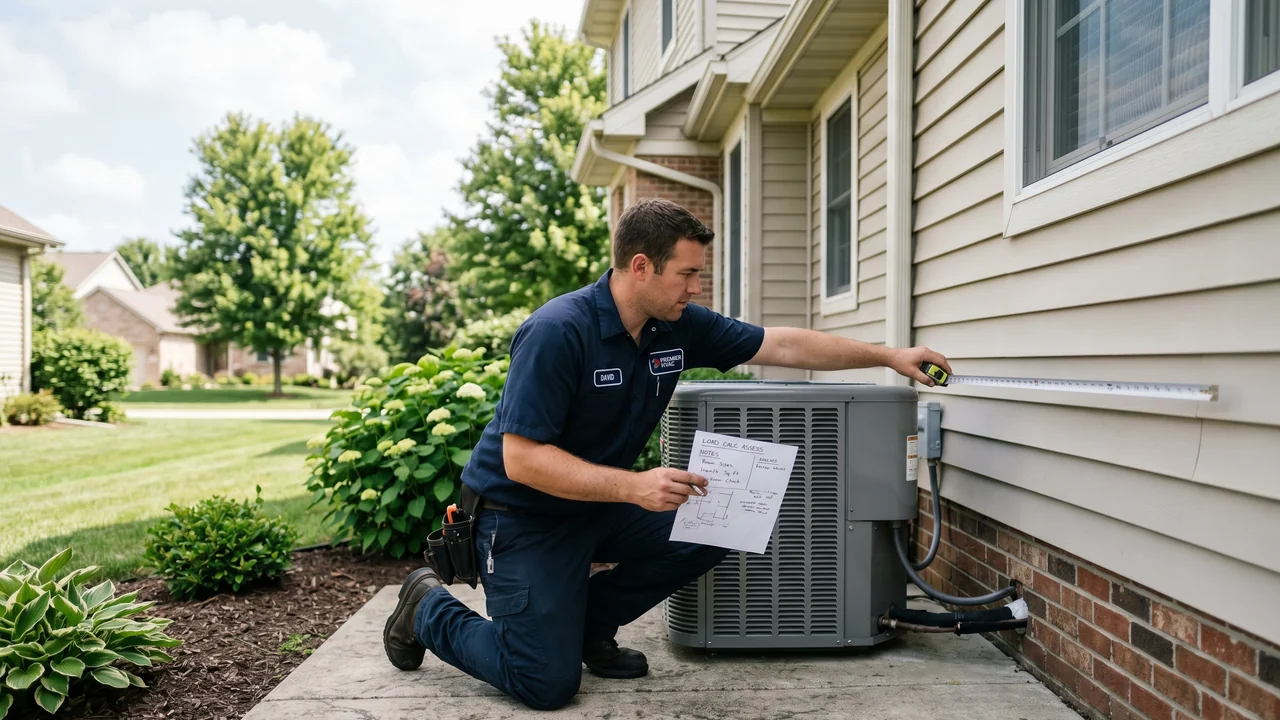
A technician can run a Manual J for your home and quote the right-sized heat pump -- not the rule-of-thumb-sized one.
Call Now — (844) 582-1795Disclosure: We are a referral service and may receive compensation for qualified calls. Calls may be routed to an independent provider network and may be recorded. Pricing and availability vary by provider and location.
The Three Costs of Oversizing
Oversizing is the easier error to miss. An oversized unit still gets the home cold or hot enough, so nobody complains, and the contractor gets little feedback on the mistake. The costs accumulate quietly across the equipment's life (DOE's federal purchasing guidance assumes a 15-year average life for a residential air-source heat pump, as a cost-modelling assumption rather than a promise for any one unit).
Cost 1: Short-cycling
A heat pump sized well above the actual load reaches setpoint quickly, shuts off, then restarts moments later. ENERGY STAR notes that a conventional system that is too large cycles on and off frequently, causing humidity control problems and inefficient operation, and that oversized units tend to have shorter lives because short-cycling inflicts excessive wear and tear on the compressor. ENERGY STAR also notes that higher-efficiency equipment with variable-speed compressors does a better job of compensating for over-sizing.
Cost 2: Failed humidity removal
The cooling-mode failure homeowners notice as "the house feels cold but clammy." Dehumidification happens over the run time of the cooling cycle -- moisture condenses out as air passes over the evaporator coil. An oversized unit's short run times don't give the coil enough time to process moisture. The indoor temperature drops to setpoint quickly (cool) but the humidity stays high (clammy). ENERGY STAR lists humidity control problems among the effects of an oversized system, and the penalty matters most in humid-summer markets like Atlanta and Dallas.
Cost 3: Higher install and operating cost without proportional benefit
A 4-ton heat pump costs more than a 3-ton to buy and install (see the installed ranges on our cost guide). Higher operating cost is more subtle: the inefficient operation that comes with frequent cycling, and -- in cooling mode -- clammy air that can push homeowners to set the thermostat lower in pursuit of comfort. You pay for capacity the home's actual load never needed.
The One Cost of Undersizing
An undersized heat pump cannot meet the home's heating or cooling load during the most demanding weather. For heating, the system runs near continuously during cold snaps and leans on backup heat -- electric-resistance strips on all-electric installations or a gas furnace on dual-fuel installations. The cost of leaning on resistance backup is direct: each kWh delivered through resistance heat is COP 1.0 (1 kWh in, 1 kWh out), versus a heat pump that moves more heat than the electricity it uses (ENERGY STAR's Cold Climate specification requires a COP of at least 1.75 even at 5°F). Excessive backup-heat runtime pushes operating cost toward resistance-heat economics.
For cooling, undersizing produces indoor temperature drift during peak summer afternoons -- the unit's BTU capacity is below the home's heat gain, so the temperature rises despite continuous operation. Unlike oversizing, this is hard to miss: the home does not reach the setpoint on the hottest afternoons.
Undersizing can happen in three ways: a homeowner downsizes equipment to save on install cost without re-running the load calc (the contractor sized for the original home; the new smaller equipment doesn't match it); shell improvements were assumed but not actually completed (the load calc assumed new insulation; the insulation wasn't installed); or the contractor used a rule of thumb that happened to land below the home's actual load.
How to Verify a Heat Pump Quote
Three specific asks turn a sizing-quote review from "I'm guessing" to "I'm checking the math."
1. "Can you share the Manual J load calculation?" A reputable contractor produces it before quoting equipment and is willing to share. The document shows assumed inputs (square footage, ceiling height, R-values, window types, infiltration), the heating and cooling loads by zone and total, and the recommended equipment capacity. A contractor who quotes without one is using a rule of thumb; get a second quote.
2. "How does the recommended equipment tonnage match the Manual J load?" The math is direct: 12,000 BTU/hr equals 1 ton. A 36,000 BTU/hr design cooling load matches a 3-ton heat pump. If the Manual J shows 28,000 BTU/hr but the recommendation is 4-ton (48,000 BTU/hr), the equipment has about 71% more capacity than the calculated load (48,000 ÷ 28,000 = 1.71) -- a classic "round up for safety" error. Reputable contractors welcome the verification; the ones who don't are the ones to walk away from.
3. "Do the Manual J inputs match my actual home?" The most important sanity check. If the Manual J assumes R-19 attic insulation and you upgraded to R-30, the calc underestimates the home's thermal performance and oversizes the equipment. If it assumes single-pane windows and you have double-pane low-E, same issue. Walk through the input assumptions against your actual home, particularly any improvements made since build.
For cold-climate sizing (Zone 5+), the cold-climate heat pump (CCHP) question matters too. To earn ENERGY STAR's Cold Climate designation, a heat pump must keep at least 70% of its 47°F heating capacity at 5°F and reach a COP of at least 1.75 at 5°F (ENERGY STAR Version 6.2 specification). In a cold climate, ask whether a Cold Climate-designated unit correctly sized to the Manual J load fits your home; an oversized standard unit or an undersized CCHP both miss the point. The cold-weather physics explainer covers the balance-point math.
Climate Context: How Region Changes the Math
The same 1,800-square-foot home with identical insulation and occupancy faces different design conditions in each market, which is why only a Manual J run with local design temperatures can size it. Climate zone and average temperatures below come from our city pages:
- Eugene, OR (Zone 4C, marine): average summer high 84°F, winter low 35°F. Mild on both ends, so ask to see the Manual J before accepting a square-footage tonnage.
- Atlanta, GA (Zone 3A, warm-humid): average summer high 89°F, winter low 34°F. Humid summers make the latent (humidity) part of the cooling load matter, and an oversized unit risks the "cool but clammy" problem.
- Dallas, TX (Zone 3A, warm-humid): average summer high 96°F, winter low 38°F. Hot summers put the cooling load, and the dehumidification penalty of oversizing, at the center of the quote review.
- Reno, NV (Zone 5B, cool-dry): average summer high 94°F, winter low 26°F. Cold winter nights put the heating load and the Cold Climate question in focus, and hot summers mean the cooling load still has to be checked.
Trusted Industry Sources
The sizing methodology, load-calc inputs, equipment-selection math, and verification framework in this article are consistent with published guidance from:
- ACCA — Technical Manuals (Manual J load calc + Manual S equipment selection)
- AHRI — Residential Equipment Certification (HSPF2 / SEER2)
- ENERGY STAR — Clean Heating and Cooling (Heat Pump certification + CCHP)
- U.S. Department of Energy — Cold Climate Heat Pump Challenge
- EPA — Section 608 Technician Certification
A technician can run the load calc for your home and quote the right-sized heat pump -- with the Manual J PDF you can verify yourself.
Call Now — (844) 582-1795Disclosure: We are a referral service and may receive compensation for qualified calls. Calls may be routed to an independent provider network and may be recorded. Pricing and availability vary by provider and location.
Frequently Asked Questions
A heat pump is correctly sized through an ACCA Manual J residential load calculation, which computes the home's actual heat loss at winter design temperature and heat gain at summer design temperature based on specific inputs: conditioned floor area, ceiling height, wall and ceiling insulation R-values, window types and orientation, infiltration rate, occupancy, and internal heat loads from lighting and appliances. The output is a BTU-per-hour number for heating and cooling loads. Equipment is selected to match that load through the ACCA Manual S equipment selection procedure. The "one ton per 500 square feet" rule of thumb is wrong because it ignores every input except square footage.
Three specific failure modes. First, short-cycling: the unit reaches setpoint quickly, shuts off, then restarts moments later — per ENERGY STAR, short-cycling inflicts excessive wear and tear on the compressor. Second, failed humidity removal during cooling: an oversized unit's short run times produce cool but clammy indoor air, particularly in humid climates. Third, higher upfront and operating cost: a 4-ton unit costs more than a 3-ton to buy and install (see our cost guide), without the larger capacity ever being useful.
An undersized unit cannot meet the home's heating or cooling load during the most demanding weather. For heating, the system runs continuously during cold snaps and leans on backup heat (resistance strips on all-electric installs, gas furnace on dual-fuel), which pushes operating cost toward resistance-heat economics. For cooling, the indoor temperature drifts upward during peak summer afternoons because BTU capacity is below the home's heat gain. Undersizing can happen when homeowners downsize equipment without re-running the load calc.
Yes, with three specific asks. First, request a copy of the Manual J load calculation that produced the recommended tonnage. A reputable contractor produces this before quoting equipment. Second, ask "what is the recommended equipment tonnage, and how does that match the Manual J heating and cooling load?" The math is direct: 12,000 BTU per ton, so a 36,000 BTU/hr design heating load matches a 3-ton heat pump. Third, sanity check the inputs against your actual home — if the Manual J assumes R-19 attic insulation and your home has R-30, the calculation is using bad inputs and the resulting size is suspect. Reputable contractors welcome verification questions.
Only by coincidence. The rule sees nothing but floor area, so it cannot account for climate, insulation, air leakage, windows, occupancy, ceiling height, or layout — the inputs a Manual J calculation uses. It persists because it is fast: Manual J needs measurements of the actual home, while the rule needs only the square footage.
They interact at the balance point — the outdoor temperature at which the heat pump's heating capacity matches the home's heat-loss demand. A correctly-sized standard heat pump in a cold climate produces a high balance point and leans on backup heat for multiple winter months. A correctly-sized cold-climate heat pump (CCHP), which under ENERGY STAR's specification must keep at least 70% of its 47°F heating capacity at 5°F, produces a lower balance point and needs backup heat on fewer hours. In Zone 5 and above, ask whether a CCHP correctly sized to your home's Manual J load fits your home. See our cold-weather heat-pump physics explainer for the balance-point math.
Local HVAC Service Areas
Cool Call Pro connects homeowners with independent HVAC technicians nationwide. Find a pro in Eugene (OR), Dallas (TX), Atlanta (GA), or Reno (NV), or browse by state: Oregon, Texas, or all locations.