
Advertising Disclosure: This site may receive compensation for service connections made through this page. Content is editorially independent.
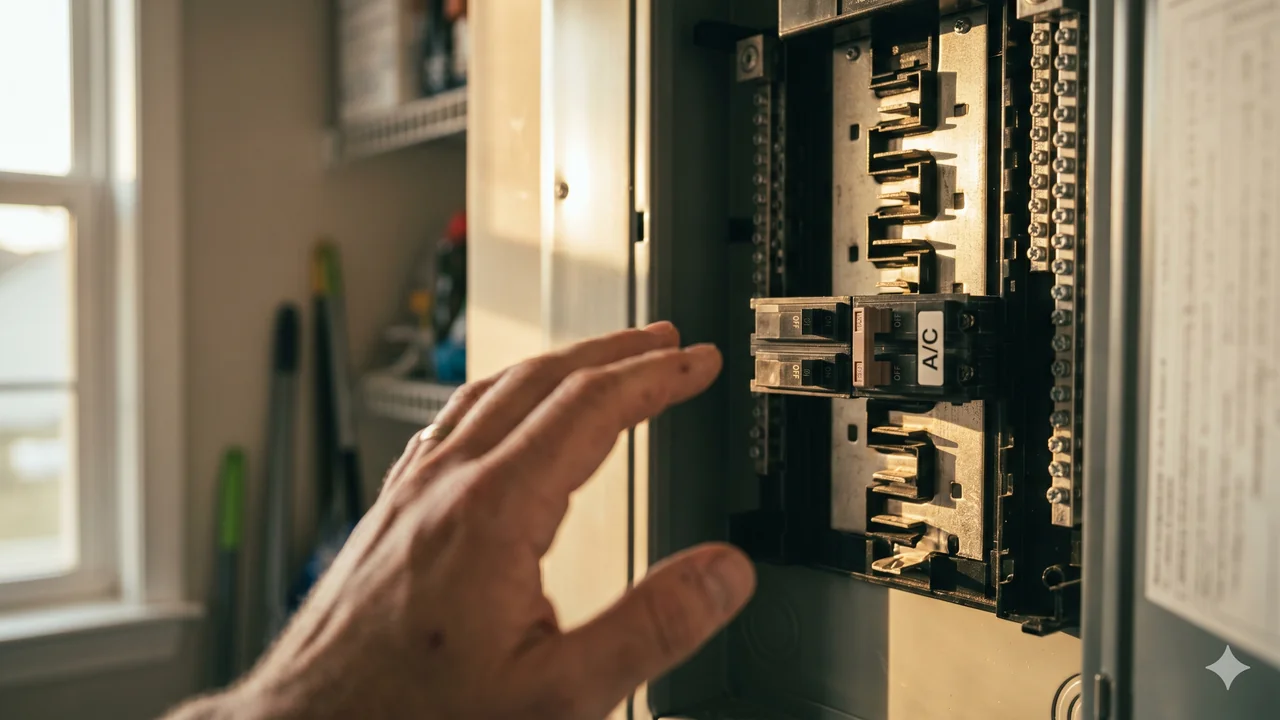
A breaker trips because something is drawing dangerous current — it's protecting you from a fire. If your AC's breaker has tripped, leave it off. Set the thermostat to off, do not reset the breaker, and call a qualified HVAC technician. Do not open the service panel. Do not open the outdoor disconnect. Do not spray the outdoor unit with water. Repeated resets on a tripping circuit are how electrical fires start — the single most valuable action you can take is making the phone call.
Circuit breakers exist because the National Electrical Code (NFPA 70) requires overcurrent protection on every residential branch circuit. When a breaker trips, it has detected a condition — sustained over-current, a short, a ground fault — that will eventually overheat the wiring and start a fire. The safest action for a homeowner is to set the thermostat to off and call a qualified HVAC technician. If the breaker has already tripped, the circuit is already open — you do not need to touch the breaker at all. Do NOT reset the breaker hoping it will hold. Do NOT open the service panel to inspect anything; residential service panels carry 240V split-phase and the bus bars are live even when individual breakers are off. Do NOT open the outdoor disconnect or the outdoor unit's cabinet. If the breaker smells hot, is warm to the back of your hand, or looks scorched, or if you see smoke or burning smell anywhere, evacuate the area and call 911 or your fire department — then call a qualified electrician. Nothing about this problem is worth a risk to your safety.
Why a Breaker Trips in the First Place
A residential central AC runs on a dedicated 240-volt, two-pole breaker — typically 30 amps or 40 amps depending on system size. The breaker's job is simple: if the circuit pulls more current than it is rated for, for long enough, the breaker opens and cuts power. There are four conditions that cause a trip:
- Sustained overload. The AC is drawing more current than rated for minutes at a time — the condition behind the filter, coil, capacitor, and compressor causes below.
- Short circuit. Two conductors touch directly (hot-to-neutral or hot-to-hot), creating a near-zero resistance path and a massive inrush of current. The breaker trips in milliseconds.
- Ground fault. Current is leaking to ground (often through a failed compressor winding that has shorted to the outdoor unit's metal cabinet). A GFCI or AFCI breaker catches this; a standard breaker may not.
- Inrush on startup. At the instant of startup a compressor draws its locked-rotor amps (LRA), far more than its running amps; both ratings are printed on the outdoor unit's nameplate. A weak capacitor or a worn compressor extends that inrush long enough to trip a standard breaker — even when the system looks fine once it gets going.
Knowing which of those four is happening changes the diagnosis. That is why this is a measurement job, not a guess job.
The 6 Root Causes of a Tripping AC Breaker
These are the six failure modes a technician works through, starting with the one a homeowner can address.
1. Clogged Air Filter or Dirty Evaporator Coil (Most Fixable)
A restricted airflow path forces the blower motor to work harder and the compressor to run longer, warmer cycles. Both draw higher amps. On a system that was already running close to breaker capacity, that extra load is enough to trip. The DIY step is the filter: ENERGY STAR advises checking it every month, changing it if it looks dirty, and changing it at least every 3 months. If a filter change does not stop the trip, see our guide on AC freezing up in summer, since a dirty coil often shows up as ice before it shows up as a breaker trip.
2. Dirty Outdoor Condenser Coil
The outdoor coil rejects all the heat the indoor coil absorbs. If the fins are packed with cottonwood fluff, grass clippings, dryer lint, or years of grime, the condenser cannot dump heat fast enough. Refrigerant pressure climbs, the compressor works harder against that pressure, and amp draw climbs with it. Professional coil cleaning is the fix — a technician will shut off power at the disconnect, inspect for pest damage, and use the right coil cleaner and water pressure. This is not a DIY task because the outdoor cabinet contains live high-voltage wiring even with the breaker off.
3. Failing Dual-Run Capacitor
The dual-run capacitor inside the outdoor unit gives the compressor and fan motor the extra push they need to start. A capacitor that has lost capacitance (microfarads) cannot supply that push, and the compressor sits in a locked-rotor condition for an extra second or two — long enough to trip the breaker. That is why the capacitor is one of the first parts a technician tests on a repeatedly-tripping AC. Related pattern covered in our guide on AC compressor buzzing, fan not spinning. Do not attempt to test or replace a capacitor yourself. Capacitors store a dangerous charge for minutes after the power is cut and must be discharged with an insulated tool.
4. Compressor Hard-Starting or Going Bad
Beyond a weak capacitor, the compressor motor itself can wear out. As the internal windings age, bearings degrade, or oil thins, the compressor takes longer to reach running speed — and each start pulls elevated inrush current for longer. A technician will measure locked-rotor amps and compare to the compressor's rated LRA stamped on the nameplate. Readings well above the nameplate rating mean the compressor is failing. A failing compressor that trips the breaker turns into a repair-or-replace decision — $1,200 to $3,500 for the compressor alone, per our cost guide. For the cost-side of that decision, see our honest 2026 HVAC cost guide.
5. Loose Connection or Short in the High-Voltage Wiring
Terminal lugs inside the outdoor disconnect, the contactor, or the compressor terminal box can loosen over years of thermal cycling. A loose connection creates high resistance, heat, and eventually an arc — which trips the breaker as current spikes. A chewed or rodent-damaged wire between the disconnect and the unit creates the same pattern. This is strictly a technician job with a multimeter and an insulated driver — there is nothing a homeowner can safely check inside any of these enclosures.
6. The Breaker Itself Is Failing (Rare)
Breakers do wear out. With age, a breaker's thermal trip element can weaken and begin tripping at currents below the rating. If a technician measures normal amp draw across the AC and the breaker still trips, the next step is replacing the breaker — and that is a qualified electrician's job, not an HVAC technician's, because it involves work inside the live service panel. Ask the electrician for a quote before the work starts.
Get connected with a technician in your ZIP code.
Call Now — (844) 582-1795Disclosure: We are a referral service and may receive compensation for qualified calls. Calls may be routed to an independent provider network and may be recorded. Pricing and availability vary by provider and location.
What You Can Safely Do Before Calling
The safe homeowner response to a tripping AC breaker is deliberately short — shorter than most troubleshooting articles — because the risk of getting it wrong is measured in fires and electrocution, not inconvenience. If you only do one thing, make the phone call. Everything else below is optional and should be skipped if you have any doubt.
- Leave the tripped breaker off. Do not flip the breaker back on. A trip means the circuit has detected a fault, and forcing that circuit to carry current again is how electrical fires start. The technician will restore power once the cause is found.
- Turn the thermostat OFF. This is the single safest action. It stops the system from attempting to restart and involves no electrical work. If the breaker is already in the tripped position, you do not need to touch the breaker at all — the circuit is already open.
- Optional, only if comfortable: replace the air filter. A fresh filter of the same nominal size and MERV rating is a no-tools task and sometimes resolves a marginal tripping pattern once the technician has verified the rest of the system. If you have any doubt, skip this and let the technician do it.
- Optional, only if you can do it from a safe distance: clear loose debris away from the outdoor unit. Pull grass, leaves, seed fluff, and stored items away from every side of the unit without touching it. Do NOT spray the unit with a garden hose, do NOT touch the outdoor disconnect, and do NOT open the cabinet. Wiring inside both the disconnect and the cabinet can still be live even when the breaker is off. If you are not fully comfortable approaching the unit from the outside, skip this step entirely.
- Call a qualified HVAC technician. This is the most valuable action you can take. The technician's measurements show whether the fault is in the AC or in the house wiring; if it is the house wiring, you will be referred to a qualified electrician.
That is the complete safe-DIY list. Do not open the service panel to inspect the breaker. Do not open the outdoor disconnect box. Do not open the outdoor unit's service panel to look at the capacitor or the contactor. Do not spray the outdoor unit with water. Do not try to measure amperage with a consumer-grade multimeter. Do not try to test or discharge a capacitor. Any of those steps puts you in direct contact with 240-volt wiring or a capacitor that can hold a lethal charge for several minutes after power is cut — and none of them speeds up the technician's diagnosis.
When to Stop and Call a Professional
Because the safety stakes are higher on this symptom than typical AC diagnostic categories, the "stop and call" list is longer. Call a technician if any of these are true:
- The AC breaker has tripped. Leave it off; the trip itself is the signal to call.
- The breaker smells hot, is warm to the back of your hand, or looks scorched or discolored. Do not touch it — call an electrician, not HVAC.
- You see visible damage to wiring at the outdoor unit — chewed insulation, blackened terminals, or a wire pulled loose.
- The system makes a loud hum or buzz without the fan spinning up before tripping. That is the classic failing-capacitor pattern.
- The system blows cold air briefly and then trips. That is the classic hard-start pattern — a compressor that pulls inrush for too long.
- The system is more than 10 years old and the breaker trips alongside weak cooling. ENERGY STAR suggests talking to a contractor about replacement once an AC or heat pump passes 10 years, especially if it needs frequent repairs.
- You have infants, elderly family members, or anyone with a heart or lung condition in the house and you can no longer run the AC safely. Move them to a cooler space while the system is being diagnosed.
For the full map of every AC failure mode and how they interconnect, see our complete AC troubleshooting guide. If your system is cooling only weakly before it trips, our guide on AC running but not cooling below 80° covers the underlying airflow and capacitor patterns. If water is now leaking from the indoor air handler as well, see how to stop HVAC water leaks before they damage drywall and flooring.
What a Technician Will Actually Check
A thorough diagnosis on a tripping AC circuit should include every one of these measurements. If a technician quotes you a repair without showing you the numbers, ask for them.
- Clamp meter on the compressor and fan motor leads. Shows running amps and locked-rotor amps. The LRA reading compared to the compressor's nameplate LRA tells you whether the compressor is within spec or on its way out.
- Capacitor microfarad test. A multimeter in capacitance mode reads the actual stored charge against the capacitor's rated value. A reading outside the tolerance printed on the capacitor's label means it gets replaced.
- Contactor inspection. Pitted or welded contact points, burned coil, or chattering on pull-in. Any of those is a replace.
- High- and low-side refrigerant pressures. High-side pressure well above normal points to a blocked condenser and explains elevated amp draw. Under EPA Section 608, refrigerant handling is federally regulated and certification is legally required — gauges and recovery are not a homeowner task.
- Voltage at the disconnect. Confirms the service panel is delivering proper 240V split-phase to the outdoor unit. Voltage below the range on the unit's nameplate while it runs indicates an upstream problem that belongs to an electrician.
- Visual inspection of wire terminations. At the contactor, the compressor terminal box, and the disconnect. Looking for scorch marks, loose lugs, and pest damage.
A technician who skips straight to "you need a new compressor" without showing you capacitor microfarads and LRA readings is guessing. Ask for the numbers.
What Repairs Cost in 2026
Pricing on this site is anchored to our complete 2026 HVAC Cost Guide, which is the single source of truth for every cost figure — no drift between articles.
- Diagnostic / service call: $65–$150 (some providers credit it toward the repair; ask when you call)
- Capacitor replacement: $150–$400
- Contactor replacement: $100–$300
- Blower motor replacement: $300–$1,000
- Compressor replacement: $1,200–$3,500
- Emergency / after-hours surcharge: $100–$300 added
- Circuit breaker replacement: electrician's job, not listed in our cost guide; ask the electrician for a quote
Ranges from our complete cost guide. Actual costs vary by region, provider, and system.
Climate Matters: Where Tripping Breakers Show Up Most
Hot-humid climates (Baton Rouge, Brownsville, the Gulf Coast): Long run cycles at high outdoor temperatures push amp draw close to breaker rating for hours at a stretch. A marginal capacitor that survived the shoulder season can fail during the first real heat wave. ENERGY STAR recommends a contractor check-up of the cooling system every spring; ask for a capacitor microfarad test as part of it.
Hot-dry climates (Irvine, Phoenix, Las Vegas): Dust-caked condenser coils are the first upstream cause to rule out. Fine desert dust bonds to coil fins and forms an insulating layer that drives head pressure up. Ask the technician to include a coil rinse and fin inspection in the spring tune-up.
Mixed-humid climates (Charlotte, Atlanta, Nashville): A more variable pattern — trips can cluster on the first true heat wave in June or July, when a system that ran fine in May is suddenly asked for peak output. That timing fits a marginal capacitor or a hard-starting compressor that only shows up under load. Browse local service providers in Louisiana, Texas, or explore all service areas.
Trusted Industry Sources
Primary sources and further reading:
- U.S. Department of Energy — Purchasing Energy-Efficient Central Air Conditioners
- EPA Section 608 — Refrigerant Handling Regulations
- NFPA 70 — National Electrical Code
- ENERGY STAR — Heating & Cooling (air filter guidance)
- ENERGY STAR Heating & Cooling
Don't wait — get a technician dispatched to your area.
Call Now — (844) 582-1795Disclosure: We are a referral service and may receive compensation for qualified calls. Calls may be routed to an independent provider network and may be recorded. Pricing and availability vary by provider and location.
Frequently Asked Questions
A breaker trips because the circuit is drawing more current than it is rated to carry, which protects the wiring from overheating and catching fire. For a residential AC, the six causes a technician checks are a clogged air filter, a dirty outdoor condenser coil, a failing dual-run capacitor, a compressor struggling to start (high locked-rotor amps), a short or loose connection in the high-voltage wiring, and the breaker itself aging out. All but the first (a filter change) require a qualified technician.
No. A breaker trips to protect you from a fire or an electrocution risk. Switching it back on forces current through a circuit that the breaker has already identified as faulted. The National Electrical Code (NFPA 70) requires overcurrent protection on residential branch circuits so that breakers can do exactly this job. If your AC's breaker has tripped, leave it off, set the thermostat to OFF, and call a technician.
Our guidance is not to reset it yourself at all. A trip means the breaker detected over-current, a short, or a ground fault, and only a technician's measurements can tell which. Set the thermostat to OFF, leave the breaker off, and book a service call. The technician will restore power once the cause is found and fixed.
Yes. A severely clogged filter restricts airflow across the evaporator coil, which forces the blower motor to work harder, the compressor to run longer cycles, and both to draw higher amps. On a marginal system — one that was already running near breaker capacity — that extra load is enough to push the circuit over the trip threshold. ENERGY STAR advises checking the filter every month, changing it if it looks dirty, and changing it at least every 3 months. If a filter change does not stop the trips, call a technician.
Start with an HVAC technician. Five of the six causes above are in the AC equipment itself — the filter, the coils, the capacitor, the compressor, or the AC's own wiring — not the house wiring. A technician will measure amp draw, test the capacitor, check refrigerant charge, and inspect the outdoor disconnect. If the measurements point to a problem upstream of the AC (a damaged breaker, a loose neutral, aluminum wiring, a failing main panel), the technician will refer you to a qualified electrician. Do NOT open the service panel yourself.
If the cause is a dirty filter, the fix is a replacement filter and no service call. If a technician is needed, our cost guide lists a diagnostic fee of $65 to $150, a capacitor replacement at $150 to $400, a contactor replacement at $100 to $300, a blower motor replacement at $300 to $1,000, or a compressor replacement at $1,200 to $3,500. A separate circuit breaker replacement is an electrician job; ask the electrician for a quote. See our full HVAC Cost Guide for the complete 2026 pricing breakdown.
Local HVAC Service Areas
Cool Call Pro connects homeowners with independent HVAC technicians nationwide. Find a pro in Baton Rouge (LA), Brownsville (TX), Irvine (CA), or Charlotte (NC), or browse by state: Louisiana, Texas, or all locations.