
Advertising Disclosure: This site may receive compensation for service connections made through this page. Content is editorially independent.
Heat pumps run on 240-volt circuits and contain capacitors that hold a lethal charge even after power is cut. The safest action for a homeowner is to set the thermostat to OFF (or Emergency Heat) and call a qualified HVAC technician. Do not kill the power by going to your service panel to flip the breaker yourself — the technician will handle the power-down and disconnect sequence on arrival. Refrigerant-side diagnosis is federally regulated under EPA Section 608, certification is legally required, and refrigerant work is never a homeowner task. Do not open the outdoor cabinet, touch the capacitor or reversing valve, chip ice off the coil, or pour water on the unit.
Heat pumps handle both heating and cooling, so a single component failure can disable both modes. Possible causes of cold air in winter include a failed reversing valve, low refrigerant, or a frozen outdoor unit. Heating capacity drops as outdoor temperatures fall; ENERGY STAR’s Cold Climate designation requires at least 70% of rated capacity at 5°F. A defrost cycle (usually 5–15 minutes, per Lennox) is normal — continuous cold air is not.
A heat pump moves heat instead of burning fuel, and ENERGY STAR says an air-source heat pump can deliver up to three times more heat energy to a home than the electrical energy it consumes — but because it handles both functions using the same refrigerant circuit and reverses direction between seasons, a single component failure can disable heating, cooling, or both. Diagnosing a heat pump problem is more complicated than diagnosing a furnace or a standard central AC because the symptoms often look the same but have different causes depending on the mode the system is in.
This guide separates heat mode failures from cool mode failures, explains what is normal behavior vs. a real problem, and ties each repair to the price ranges in our cost guide so you can make a smart decision.
How Does a Heat Pump Work?
A heat pump does not generate heat by burning fuel — it moves heat from one place to another. In summer, it works exactly like a central air conditioner: it absorbs heat from indoor air and dumps it outside. In winter, it reverses this process, extracting heat from outdoor air (even in cold weather, there is usable heat energy in outdoor air down to well below freezing) and moving it inside.
The component that makes this reversal possible is the reversing valve — a solenoid-controlled valve in the refrigerant line that redirects refrigerant flow between heating and cooling directions. When the reversing valve fails, the system gets stuck in one mode. Because the symptoms can look like a refrigerant or airflow problem, a stuck reversing valve is easy to misread without a technician's pressure readings.
Everything else in a heat pump — the compressor, capacitors, contactors, refrigerant circuit, and air handler — works essentially the same as a conventional split AC system. The diagnostic approach for those components is the same.
Why Is My Heat Pump Blowing Cold Air in Winter?
If your heat pump runs in winter but produces little or no warm air, the causes below run from the simplest to check to the most involved repair. Only the first (the air filter) is a homeowner task; the rest are for a technician to confirm.
1. Clogged Air Filter
A dirty air filter restricts airflow across the evaporator coil. In heat mode, this limits how much heat the system can transfer to indoor air. The result: the air handler runs, air comes out, but it feels barely warm. Check the filter first. If it is gray and dense, replace it and run the system for 30 minutes before concluding there is a deeper problem.
2. Normal Defrost Cycle
In cold, humid weather, frost accumulates on the outdoor coil. The heat pump periodically enters a defrost cycle — it temporarily switches to cooling mode to melt the frost. Lennox says a defrost cycle usually lasts between 5 and 15 minutes, and warm air production pauses briefly while it runs, so the vents may feel cooler. This is normal and not a malfunction. See the defrost cycle section below for how to distinguish a normal defrost from an abnormal one.
3. Failed or Stuck Reversing Valve
The reversing valve is heat pump-specific. When it fails, the system can get stuck in cooling mode even when set to heat. Symptoms: the outdoor unit runs normally, but you feel cool or room-temperature air from the vents in heat mode. A technician confirms this with refrigerant pressure readings — the suction and discharge pressures in the lines will be reversed relative to what they should be in heat mode.
Our cost guide has no separate line for reversing valves, so ask for a written quote after diagnosis. Sometimes only the solenoid (the electrical coil that shifts the valve) has failed, which is a smaller job than replacing the valve body. Because the valve sits inside the refrigerant circuit and is labor-intensive to reach, a failed reversing valve on an older system is a good moment to weigh repair against replacement.
4. Low Refrigerant
A refrigerant leak affects heat mode and cool mode equally — the system cannot move heat effectively in either direction. In winter, low refrigerant often shows up as ice accumulating on the outdoor unit that does not clear during defrost cycles. See our refrigerant leak guide for the full repair process and costs.
5. Outdoor Unit Frozen Solid
In very cold, wet weather, the outdoor unit can accumulate ice faster than the defrost cycle can clear it. A coil encased in thick ice cannot absorb heat from outdoor air. The system runs but produces no meaningful heat output. Set the thermostat to emergency heat (or OFF), let the ice melt on its own — do not chip, scrape, spray, or heat it — and call a technician to find out why the defrost cycle is not keeping up.
6. Thermostat Set to Emergency Heat
If someone has set the thermostat to "Emergency Heat" (or "Em Heat"), the heat pump is bypassed entirely and only the backup electric resistance strips or gas furnace runs. That is the right setting while you wait for a technician after an ice-up or a failure, but backup heat does not get the heat pump’s efficiency advantage. If no one changed it for a reason, set the thermostat back to "Heat" mode.
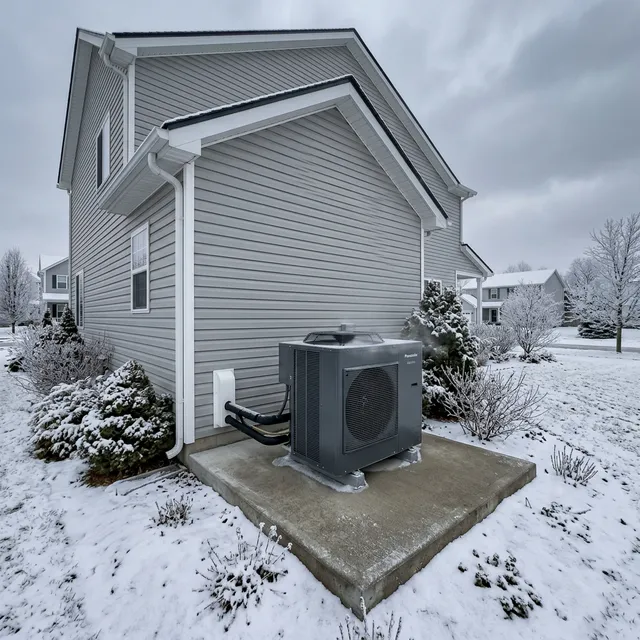
In freezing weather, heat pumps can ice over — this is a known technician-handled problem. From inside the house or a safe distance, check whether the outdoor unit is visibly encased in ice. If it is, set the thermostat to emergency heat (or fan-only if there is no emergency heat option) and call a technician. Do not try to chip, spray, or physically clear ice from the unit, do not approach the unit to scrape snow off it, and do not open the cabinet to inspect anything inside. A technician will safely thaw the unit, identify why the defrost cycle failed, and restore normal operation.
Why Is My Heat Pump Blowing Warm Air in Summer?
In cooling mode, a heat pump behaves identically to a standard split AC system. All of the same failure modes apply:
- Failed run capacitor: The capacitor provides the electrical jolt that starts and runs the compressor and fan motors. A failed capacitor means the outdoor unit hums but does not start. Cost: $150–$400 (see our cost guide).
- Dirty condenser coil: The outdoor coil must be able to reject heat to the air. A coil packed with debris moves heat inefficiently and reduces cooling capacity. Coil cleaning is a technician task during a tune-up; do not hose or spray the coil yourself.
- Low refrigerant: Same as in heat mode — the system cannot move heat in either direction when refrigerant is low.
- Failed compressor: The compressor is the heart of the refrigerant circuit. A failed compressor means no cooling (or heating). Cost: $1,200–$3,500. On a heat pump more than 10 years old — the age at which ENERGY STAR suggests calling a contractor about replacement — get a replacement quote before approving a compressor repair.
- Stuck reversing valve: Can get stuck in heat mode, causing the system to try to heat when you have set it to cool.
If your heat pump provides adequate cooling in summer but struggles in winter (or vice versa), that pattern points toward the reversing valve, which controls the switch between modes. If it struggles in both modes, focus on refrigerant level, compressor condition, or airflow issues.
Connect with a local independent HVAC technician for a heat pump diagnosis. Ask for the diagnosis and a written quote before any repair work begins.
Call Now — (844) 582-1795Disclosure: We are a referral service and may receive compensation for qualified calls. Calls may be routed to an independent provider network and may be recorded. Pricing and availability vary by provider and location.
What Is the Heat Pump Defrost Cycle?
The defrost cycle is normal behavior that can look alarming: steam, a whooshing sound, a pause in warm air. Knowing what it looks like can save you an unnecessary service call. The descriptions below follow Lennox’s homeowner guide to the defrost cycle.
What Normal Defrost Looks Like
- Steam or vapor rises from the outdoor unit as frost melts
- Warm air production pauses briefly; many systems switch on backup or auxiliary heat strips to limit the indoor temperature drop
- A whooshing sound as the system shifts modes
- Duration: usually 5–15 minutes, then the system switches back to heating
When Defrost Becomes a Problem
- Defrost runs much longer than usual, or long cycles repeat, without the unit returning to heat mode
- Ice does not fully clear between defrost cycles, leaving the coil partially or fully encased
- Defrost cycles seem to happen too often
Lennox lists dirty or blocked coils, faulty sensors or controls, and low refrigerant charge or other mechanical issues as possible causes of excessive defrost. A technician tests the defrost sensor and control board, checks the refrigerant charge, and confirms the reversing valve is switching fully. Our cost guide has no separate line for defrost sensors or boards, so ask for a written quote.
Do Heat Pumps Work in Cold Climates?
Yes, but heating capacity falls as the outdoor temperature drops, and backup heat makes up the difference when the heat pump can no longer keep up. How far down a given heat pump performs depends on the model. To earn ENERGY STAR’s Cold Climate designation, a heat pump must keep at least 70% of its 47°F heating capacity at 5°F and reach a COP (heat output per unit of electricity) of at least 1.75 at 5°F, per the ENERGY STAR Version 6.2 heat pump specification. ENERGY STAR says these units keep working below 5°F, but pairing them with a backup heat source is the most efficient way to heat the home at even lower temperatures.
If your heat pump is not a cold-climate model and leans on backup heat during your area’s coldest weather, that can be expected behavior for the equipment rather than a malfunction. A technician can confirm which it is from the model number. For why output drops in the cold, see Heat Pumps in Cold Weather: The Physics.
If your heat pump struggles in temperatures your area regularly experiences, and you have a standard (non-cold-climate) model, the correct solution may not be a repair — it may be upgrading to a cold-climate model or adding a dual-fuel backup.
How Much Does Heat Pump Repair Cost in 2026?
Repair costs depend on the part, its location in the system, your region, and whether the call is routine or emergency-dispatched. Where our cost guide has a matching line, the range below is copied from it; parts without a /costs line are marked “Written quote.” Expect a diagnostic / service-call fee of $65–$150 per visit.
| Problem | Typical Repair Cost | DIY Possible? | Notes |
|---|---|---|---|
| Air filter replacement | Cost of the filter | Yes | Do this first before any other diagnosis |
| Thermostat replacement | $150–$500 (smart) | No | Smart thermostats require correct heat pump configuration |
| Defrost sensor replacement | Written quote | No | No separate /costs line |
| Defrost control board | Written quote | No | Required when defrost fails to initiate correctly |
| Run capacitor | $150–$400 | No | Helps start and run the compressor and fan motors |
| Contactor replacement | $100–$300 | No | Switches power to the outdoor unit |
| Reversing valve replacement | Written quote | No | Heat pump-specific; labor-intensive |
| Refrigerant recharge (R-410A) | $150–$600 | No | Recharge only; leak repair quoted separately. EPA Section 608 certification required |
| Blower motor replacement | $300–$1,000 | No | Indoor or outdoor fan motor |
| Compressor replacement | $1,200–$3,500 | No | On older units, get a replacement quote too |
| Full heat pump system replacement (ducted, 2–3 ton, standard efficiency) | $7,600–$9,500 | No | Installed; 2022-dollar estimate from an NREL/LBNL cost model. Cold-climate and high-efficiency systems cost more |
| After-hours / emergency premium | +$100–$300 | — | Surcharge added to the repair cost on nights and weekends |
Should I Repair or Replace My Heat Pump?
Because a heat pump provides both heating and cooling, it runs in both seasons. DOE’s federal purchasing guidance assumes an average service life of 15 years for an air-source heat pump; that is a life-cycle-cost modelling assumption, not a promise of how long any one unit will last. Use these rules of thumb alongside a technician’s diagnosis:
Multiply the repair quote by the system’s age in years. If the result is more than $5,000, get a replacement quote before approving the repair. Example: a $400 capacitor repair on a 6-year-old system = $2,400 — repair is reasonable. A $1,800 compressor repair on a 12-year-old system = $21,600 — get a replacement quote. This is a rule of thumb, not a formal standard, and it does not replace a technician’s diagnosis.
- Under 10 years old: Run the $5,000 rule on the quote. Smaller repairs such as a capacitor or contactor pass it easily on a young system; a compressor replacement ($1,200–$3,500) can fail it once the system is around five years old.
- More than 10 years old: ENERGY STAR suggests it may be time to call a contractor about replacement when a heat pump is more than 10 years old, or when it needs frequent repairs while energy bills are going up. ENERGY STAR says certified units, installed correctly, can save up to 20 percent on heating and cooling costs.
- The 50% rule: A second rule of thumb is to get a replacement quote when a repair would cost more than half the price of a comparable new system.
- Standard HP in a cold climate: If you have a standard (non-cold-climate) heat pump in a region with long stretches of below-freezing weather and are considering replacement, prioritize a cold-climate model. It keeps more of its heating capacity at low temperatures (see the ENERGY STAR criteria above), so it leans less on backup resistance heat.
See our full HVAC repair cost guide for a broader breakdown of repair vs. replacement costs across system types. If replacement is on the table, our 2026 Heat Pump Buyer’s Guide covers system types, cold-weather performance, and rebates before you collect quotes.
Connect with a local independent HVAC provider for a heat pump service call. Ask for the diagnosis and a written quote before any repair work begins.
Call Now — (844) 582-1795Disclosure: We are a referral service and may receive compensation for qualified calls. Calls may be routed to an independent provider network and may be recorded. Pricing and availability vary by provider and location.
Frequently Asked Questions
Possible causes include a failed reversing valve stuck in cooling mode, low refrigerant from a leak, a normal defrost cycle (Lennox says defrost usually lasts 5 to 15 minutes), a dirty air filter restricting airflow, or an outdoor unit frozen solid. If the system blows cold air continuously in heat mode and is not in a defrost cycle, it needs a technician’s diagnosis.
There is no single cutoff temperature. A heat pump’s heating capacity falls as it gets colder outside, and backup heat makes up the difference. To earn ENERGY STAR’s Cold Climate designation, a heat pump must keep at least 70% of its 47°F heating capacity at 5°F and reach a COP of at least 1.75 at 5°F. ENERGY STAR says these units keep working below 5°F, but pairing them with a backup heat source is the most efficient way to heat the home at even lower temperatures. If your heat pump is not a cold-climate model and struggles in cold weather, that can be expected behavior for the equipment rather than a malfunction.
During defrost the system briefly switches to cooling mode to melt frost on the outdoor coil. Lennox says you may see steam rising from the outdoor unit, hear a whooshing sound as the system shifts modes, and notice a short pause in warm air; the cycle usually lasts 5 to 15 minutes. Defrost that runs much longer, happens too often, or leaves ice on the coil warrants a service call.
It can. ENERGY STAR says certified cold-climate heat pumps keep working below 5°F, but pairing one with a backup heat source is the most efficient way to heat the home at even lower temperatures. In colder regions, that backup can be the existing gas furnace (a dual-fuel setup) or electric resistance heat. Correct sizing matters either way. Our guide Should I Switch From a Gas Furnace to a Heat Pump? walks through the decision.
DOE’s federal purchasing guidance assumes an average service life of 15 years for an air-source heat pump. That is a life-cycle-cost modelling assumption, not a promise of how long any one unit will last. ENERGY STAR suggests it may be time to talk to a contractor about replacement once a heat pump is more than 10 years old, or sooner if it needs frequent repairs while energy bills are going up.
- U.S. Department of Energy — Cold Climate Heat Pump Challenge
- ENERGY STAR — Heat Pumps
- ENERGY STAR — When to Replace Heating & Cooling Equipment
- DOE FEMP — Purchasing Energy-Efficient Air-Source Heat Pumps
- Lennox — Understanding the Heat Pump Defrost Cycle
- EPA — Section 608 Refrigerant Regulations
- ACCA — Quality Installation Standards
Local HVAC Service Areas
Cool Call Pro connects homeowners with independent HVAC technicians nationwide. Find a pro in Charlotte (NC), Birmingham (AL), Oklahoma City (OK), or your city. Browse state HVAC guides: North Carolina, Alabama, and Oklahoma.